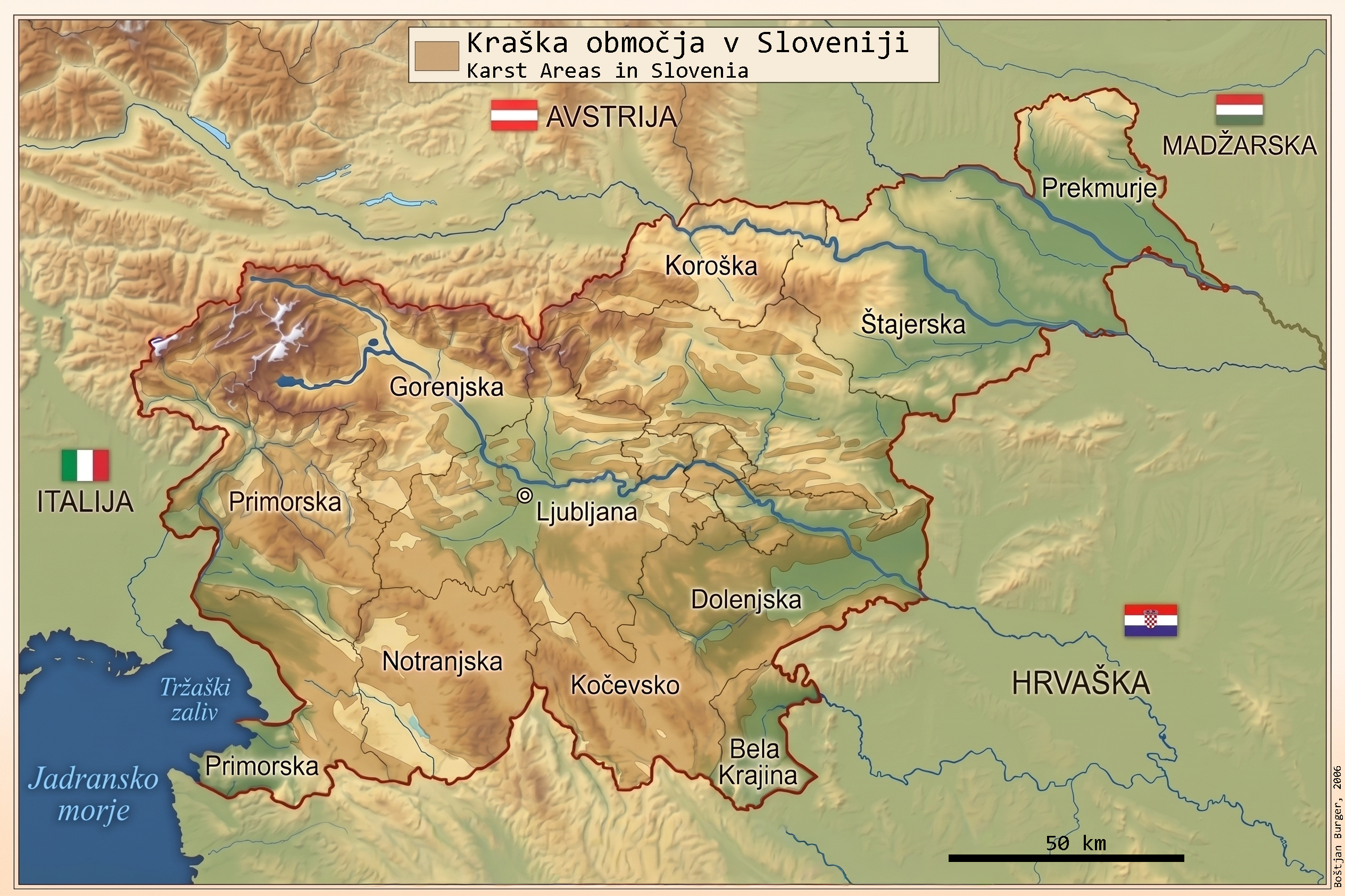

1. The Distinction Between the Terms Karst and karst
-
Karst (capitalized): The proper geographic name for the Classical Karst (Slovene: Kras)—a limestone plateau in southwestern Slovenia (and partly in Italy) bounded by the Gulf of Trieste, the Vipava Valley, Brkini, and the Soča (Isonzo) plain. It was here in the 19th century that the first systematic scientific investigations of such terrain were conducted, transforming the local Slovene regional name into the universal international scientific term for all corresponding landscapes worldwide (karst in English and German, carso in Italian).
-
karst (lowercase): A generic concept in geomorphology and geology. It designates a distinctive terrain and subterranean landscape formed through the chemical dissolution of soluble rocks (limestone, dolomite, gypsum, halite), characterized by specialized surface and underground forms as well as predominantly subterranean drainage. Karst environments exist across the globe—from the Dinaric Karst to regions in China, Mexico, or Madagascar.
2. Karstology as a Science
Karstology is the interdisciplinary science dedicated to the comprehensive study of karst systems. It synthesizes geology, geomorphology, karst hydrology, chemistry, biology (principally speleobiology), cave meteorology, and physical geography. Karstology investigates the mechanisms of rock dissolution and mineral deposition, the dynamics of underground conduit networks, the evolution of cave systems, and the pronounced vulnerability of karst aquifers to contamination.
Slovenia—notably the Karst Research Institute ZRC SAZU in Postojna—is recognized worldwide as the historical cradle and one of the preeminent global research hubs of this discipline. In the latter half of the 20th century, Academician Prof. Dr. Ivan Gams and Dr. Peter Habič contributed crucially to its transition into a modern empirical science, establishing the Slovenian Classical Karst as an international benchmark region.
3. Geological Epochs of Limestone Deposition and the Age of Slovenian Caves
To comprehend karst evolution, a fundamental distinction must be drawn between the age of the host rock (when sediments were deposited on ancient seabeds) and the age of the caves (when subterranean conduits were carved out by underground water).
a. Geological Epochs of Carbonate Rock Formation in Slovenia
The vast majority of limestones and dolomites hosting Slovenian caves were deposited during the Mesozoic Era (252 to 66 million years ago) and the early Cenozoic (Paleogene) within the warm, shallow waters of the Tethys Ocean (predominantly across the Adriatic-Dinaric Carbonate Platform):
-
Cretaceous (145 to 66 million years ago): The overwhelming majority of world-renowned caves across the Classical Karst and Notranjska developed within thick Cretaceous limestones. In shallow tropical seas, vast accumulations of rudist bivalve shells, foraminifera, and corals built massive bioherms. Within these dense beds of Cretaceous limestone, systems such as Postojna Cave and the Škocjan Caves were carved.
-
Jurassic (201 to 145 million years ago): Jurassic limestones and dolomites, laid down in quiet marine environments, host extensive cave networks across the Notranjska and Dolenjska karst, including the famous water cave Križna jama.
-
Triassic (252 to 201 million years ago): Within Triassic formations (chiefly Dachstein limestone and Main Dolomite), monumental abysses and high-altitude alpine caves of the Julian Alps, Kamnik-Savinja Alps, and Karawanks developed (e.g., vertical cave systems on Mount Kanin, Rombonski podi, and Potočka zijalka).
-
Paleocene and Eocene (Paleogene, 66 to 45 million years ago): The terminal carbonate deposition phase prior to regional tectonic uplift; Alveolina-Nummulites limestones host peripheral cave sections of the Primorska karst and Istria.
b. When Did the Caves Themselves Form (Speleogenesis)?
While the rocks themselves are tens to hundreds of millions of years old, the caves are, in geological terms, substantially younger. Active karstification could only initiate once tectonic collision during the Alpine orogeny uplifted the marine seabed into subaerial dry land. Most of Slovenia's major cave systems began developing intensively during the Neogene (Miocene and Pliocene, 20 to 3 million years ago) and continued through the Quaternary, as surface rivers draining impermeable flysch plunged into fractured limestone strata.
4. Paleokarst (Fossil Karst) – Archives of Ancient Karst Periods
In addition to actively evolving karst systems, karstology and geology recognize paleokarst (fossil karst). This represents karst developed during distant geological epochs under vastly different morphogenetic and climatic regimes, subsequently buried by younger sedimentary strata due to marine transgression or tectonic subsidence, effectively isolating it from modern meteoric circulation and speleogenetic processes.
Geological history distinguishes three primary categories of paleokarst:
-
Buried (True Fossil) Karst: Ancient karstified surfaces containing paleodolinas, karren, and ancient caves completely concealed beneath younger impermeable rock layers (such as marls, sandstones, or volcanic ash). These fossil pockets and sinkholes frequently host economically significant mineral reserves, notably bauxite (aluminum ore) accumulated under Mesozoic tropical conditions on weathered limestone before subsequent marine transgressions (typical in Istria, Herzegovina, and Dalmatia).
-
Relict Karst: Karst landforms generated in prior geological epochs under radically different climatic regimes (e.g., warm, humid Tertiary tropical conditions) that have remained subaerially exposed, undergoing only slow modification under contemporary temperate climates. Examples include rounded relict conical hills and deep accumulations of terra rossa soils in parts of Notranjska and Primorska.
-
Exhumed (Unroofed) Karst: Formerly buried paleokarst re-exposed at the surface through modern denudation and erosion. Once rivers and surface stripping strip away impermeable overlying caprock (such as flysch), the primordial relief re-emerges with its fossil cave entrances and karren, often integrating into active modern hydrological cycles (rejuvenated karst).
5. Karst as a Chemical Process
The chemical foundation of karstification is corrosion—the dissolution of carbonate rock by weak carbonic acid. Pure water dissolves almost negligible quantities of limestone; dissolved carbon dioxide (CO2), absorbed from the atmosphere and in far greater concentrations from biologically active soil horizons (root respiration and microbial activity), plays the pivotal role.
H2O + CO2 ↔ H2CO3
2. Dissolution of Limestone (Calcium Carbonate):
CaCO3 + H2CO3 ↔ Ca(HCO3)2
3. Complete Equilibrium Reaction:
CaCO3 + H2O + CO2 ↔ Ca2+ + 2HCO3−
4. Speleothem Deposition via CO2 Degassing in Cave Voids:
Ca2+ + 2HCO3− → CaCO3↓ + H2O + CO2↑
6. Karst as a Physical and Hydrodynamic Process
-
Erosion and Corrasion (Mechanical Abrasion): Water laden with sediment, gravel, and sand mechanically abrades and downcuts the beds of subterranean rivers and underground canyons.
-
Gravitational Breakdown and Collapse: Progressive enlargement of subterranean voids gradually undermines ceiling structural integrity, triggering gravitational collapse and the formation of collapse dolinas (udornice / collapse shafts).
-
Hydrodynamics of Karst Aquifers: Groundwaters in karst do not slowly filter through interstitial pore spaces as in sand aquifers; rather, they flow turbulently through open conduits, fractures, and solution channels. Consequently, flow rates are exceptionally high, accompanied by virtually nonexistent natural filtration and aquifer self-purification capacity.
7. Karst as a Geomorphological System
-
Surface Landforms (Epikarst):
Micro-forms (Karren): Rillenkarren, rinnenkarren, clints, and grikes (škrapljarji).
Depressions: Dolinas (sinkholes), uvalas (compound depressions), and karst poljes (vast closed plains subject to seasonal inundation with ponors).
Intermittent Lakes: E.g., Lake Cerknica (Cerkniško jezero).
-
Subterranean Landforms (Endokarst): Vertical shafts, horizontal cave conduits, massive underground chambers, sumps (siphons), and speleothems (stalactites, stalagmites, draperies, rimstone dams, helictites).
-
Karst Hydrography: Absence of continuous surface river systems, sinking streams (blind valleys), ponors (swallow holes), estavelles, and high-yield karst springs.
8. Geomorphology of Karst Landscapes – Global and Slovenian Karst Types
The dynamic interplay of climate, tectonics, limestone thickness, purity, and hydrological gradient creates diverse macro-relief karst landscapes across the globe:
-
Dolina Landscape / Cockpit Karst: Characterized by densely clustered, star- or bowl-shaped depressions (dolinas and uvalas) enclosed by residual limestone ridges and rounded hills. Viewed from above, the surface resembles smallpox scarring (hence the historical term "boginasti kras"). In temperate zones, this constitutes the classic archetype of the Dinaric Karst, whereas in the humid tropics it deepens into dramatic closed basins (cockpits). Examples: in Slovenia, the central Classical Karst, the Matarsko Podolje plateau, Notranjska, and parts of Dolenjska; globally, the Cockpit Country of Jamaica and sections of central Vietnam.
-
Cone Karst (Kegelkarst): Develops under warm, humid tropical and subtropical conditions with heavy rainfall and elevated temperatures, where aggressive dissolution lowers base levels while residual rock masses form hemispherical or conical towers mantled in lush vegetation. Examples: absent in modern Slovenia due to temperate climate (save for relict Tertiary paleokarst landforms in Notranjska); globally exemplary in the Chocolate Hills of Bohol (Philippines) and Gunung Sewu in Java (Indonesia).
-
Tower Karst (Turmkarst): A mature evolutionary stage of tropical karst where intervening valleys have dissolved down to regional base level or alluvial floodplains, from which isolated vertical limestone towers and pinnacles rise dozens or hundreds of metres into the air. Examples: Guilin and Yangshuo in Guangxi (China), Ha Long Bay (Vietnam), and Gunung Mulu National Park (Malaysia).
-
Alpine (High-Mountain) Karst: Karst developing in cold, elevated alpine belts above the tree line where Pleistocene glaciations stripped away all soil mantles. Marked by vast karren fields (podi), deep solution chasms, snow-plugged shafts, and near-vertical abysses plunging hundreds of metres. Examples: in Slovenia, Kaninski podi, Rombonski podi, Kriški podi, and the Dleskovška plateau; globally, the Dachstein and Totes Gebirge plateaus in Austria, and the Velebit massif in Croatia.
-
Pinnacle Karst and Stone Forests (Tsingy): Intricately etched limestone landscapes boasting razor-sharp spires, blades, and deep vertical clefts carved by intense tropical rainwater run-off along intersecting joint networks. Examples: Tsingy de Bemaraha in Madagascar (UNESCO) and the Shilin Stone Forest in Yunnan, China.
-
Fluvial Karst (Fluviokarst): A transitional terrain where active surface rivers and deep gorges closely interlace with karst landforms (blind valleys, ponors, and caves). Examples: in Slovenia, the Reka River canyon leading into the Škocjan Caves, Rakov Škocjan, and the Kolpa and Krka river valleys; globally, the Grands Causses in France and the Tara River canyon in Montenegro.
9. Shallow (Planar) vs. Deep Karst – Energy Regimes and Evolutionary Stages
Shallow karst (frequently termed incomplete or planar karst) and deep karst (defined in classical karstology as complete or deep Dinaric karst) represent two distinct evolutionary phases and morphological expressions of the identical core process: carbonate dissolution. The scientific contrast between them rests not merely on the absolute vertical depth of underground voids, but upon overall hydrodynamic potential, carbonate sequence thickness above impermeable basement, elevation relative to regional base levels, and rates of relief evolution.
Shallow karst represents an evolutionary phase where karstification is youthful or constrained by geological settings precluding deep vertical drainage. The thickness of soluble beds above impermeable substratum is modest, typically between 20 and 80 metres (rarely exceeding 100 metres), while regional water tables reside near the surface. While chemical corrosion proceeds, the vast majority of processes operate within or near the epikarst zone. The relief remains subdued, characterized by shallow dolinas, broad depressions, seasonal poljes, small swallow holes, and short, shallow subterranean stream passages. Hydrography remains mixed: surface watercourses persist and flow openly, as the shallow fractured bedrock package lacks sufficient vertical relief to absorb entire drainage networks underground. Shallow karst is geomorphologically stable and subdued; water moves sluggishly, solution is diffuse, and caves are brief, low, and predominantly sub-horizontal with negligible vertical relief. In Slovenia, classic examples include Bela krajina (where shallow limestones along the Lahinja and Krupa rivers interlace surface waterways, marshes, and gentle dolina topography), the Dolenjska lowland along the Krka River, and isolated carbonate pockets such as the Ponikva Karst.
Deep karst develops within thick successions of pure carbonate rock subject to active tectonic uplift, falling regional base levels, and dense networks of vertical faults that drive rapid vertical drainage. Here, carbonate formations reach thicknesses of hundreds to over a thousand metres; the vadose zone across Notranjska and the Classical Karst measures 200 to over 500 metres deep, while vertical ranges across alpine plateaus span 1,000 to 1,500 metres. Water does not linger on the surface of deep karst; it plunges immediately into the underworld. This unleashes intense vertical corrosion and corrasion, unroofed caves, sheer collapse dolinas, canyons, and colossal vertical shafts. Cave systems are extensive, multi-tiered, and characterized by enormous vertical pitches, sumps, active subterranean river canyons, and complex speleogenetic sequences. Deep karst is dynamic, hydraulically aggressive, and geomorphologically explosive. Water operates like a blade, slicing with immense kinetic energy through hundreds of metres of limestone, creating precipitous fault scarps and sculpting cave networks descending more than a vertical kilometre. In Slovenia, deep karst predominates across the high Dinaric plateaus (Trnovo Forest, Hrušica, Nanos, Javorniki, Snežnik plateau), the high alpine Julian Alps (Kaninski and Rombonski podi, hosting shafts deeper than 1,300 to 1,500 metres such as Čehi 2, Renejevo Brezno, and Mala Boka), and along the Karst Edge (Kraški rob) and central Classical Karst.
The definitive divergence between these two regimes resides in kinetic energy and geological history. If shallow karst is an open, tranquil chronicle legible on an open plain where water meanders without the capacity for deep incision, deep karst is a multi-tiered subterranean library where events unfold vertically through the kinetic drive of descending flows. Grasping this distinction is foundational for interpreting the Slovenian landscape: this exact hydrodynamic threshold illuminates why the Karst Edge represents such a dramatic boundary—above its cliffs lies deep karst with vertical conduits and monumental underground drainage systems, while below it the terrain descends into gentler, shallow surfaces with expansive geomorphology.
10. Distinctive Karst Fauna and Flora
Due to the sharp contrast between perpetual subterranean darkness and sun-drenched, wind-scoured, arid surface conditions, karst hosts specialized ecosystems marked by exceptional biodiversity and high levels of endemism:
a. Subterranean Cave Fauna
The cave environment is characterized by perpetual darkness, constant temperature (approximating the mean annual surface temperature), and near-saturating atmospheric humidity (~100%). Animals adapted to obligate subterranean life (terrestrial troglobionts and aquatic stygobionts) display convergent evolutionary adaptations: complete anophthalmy (loss of eyes), depigmentation (pale pink or translucent white integument), elongated sensory appendages (antennae and tactile setae), and low metabolic rates coupled with extraordinary longevity:
-
Olm / Proteus (Proteus anguinus): The largest obligate cave-dwelling amphibian on Earth and the iconic emblem of the Dinaric Karst. It exhibits neoteny (retaining external gills into adulthood), lacks functional eyes, and possesses skin covered in hypersensitive electro- and mechanoreceptors. In the dark depths of underground rivers, it can endure years of complete starvation and achieve life spans exceeding a century. In Bela krajina, a unique melanistic subspecies resides—the black olm (Proteus anguinus parkelj), which retains pigmentation and functional eyes.
-
Slenderneck Beetle (Leptodirus hochenwartii): The first scientifically described troglobitic insect in history (discovered in 1831 in Postojna Cave), whose discovery inaugurated the global science of speleobiology. It features a remarkably constricted pronotum, an inflated bulbous abdomen, and elongated, slender antennae for detecting air currents and prey in absolute dark.
-
Karst Cave Shrimp (Troglocaris anophthalmus): A delicate, entirely translucent aquatic crustacean inhabiting calm subterranean cave pools. Its glassy exoskeleton offers an unobstructed view of its internal organ systems.
-
Cave Amphipod (Niphargus): A diverse genus of blind, milky-white subterranean amphipods occupying cave pools, phreatic fissures, and epikarst dripwater reservoirs throughout the Karst.
-
Cave Tubeworm (Marifugia cavatica): The world's only known freshwater cave serpulid polychaete worm, secreting calcareous tubes upon submerged bedrock in underground rivers to filter-feed and sustain dense subterranean colonies.
b. Surface Flora of the Karst (Light, Rock, and the Bora Wind)
Despite substantial regional rainfall, surface water immediately drains through fractured bedrock into the deep underworld, making the surface exceptionally drought-prone. Surface flora has adapted to severe water deficits (xerophytic adaptations), skeletal shallow soils, intense solar radiation, and violent gusts of the Bora wind:
-
Smoketree / Cotinus (Cotinus coggygria): A signature karst deciduous shrub with an extensive, deep root network resistant to skeletal limestone terrain. Its most dramatic spectacle unfolds in autumn, when anthocyanin accumulation paints its foliage in brilliant shades of fiery crimson, scarlet, and amber, transforming the karst commons into an incandescent landscape.
-
Turkey Oak (Quercus cerris) and Downy Oak (Quercus pubescens): Dominant indigenous oak species of ancient karst woodlands. Downy oak leaves are cloaked beneath in dense, velvety hairs that curb moisture transpiration during arid Mediterranean summers.
-
Winter Savory (Satureja montana) and Karst Thyme (Thymus serpyllum): Low-growing, aromatic dwarf shrubs whose essential oils minimize leaf transpiration, imparting a signature scent to dry karst grasslands and providing vital nectar for Karst honey production.
-
Wild Peony (Paeonia officinalis): A striking spring relict wildflower bearing large, deep-crimson blossoms on rocky meadows across high karst ridges (e.g., Mount Slavnik and Vremščica).
-
Austrian Black Pine (Pinus nigra): Though not universally native across the entire Classical Karst, it defined the region's modern visual identity. Systematically planted in the 19th century under state afforestation programs, its dense needles and vigorous root mats served to blunt the Bora's force and arrest catastrophic soil erosion across the barren limestone plateau.
11. Karst as a Socio-Cultural Concept and Architectural Heritage
The Karst is not merely a geomorphological phenomenon; it is one of Europe's most distinctive cultural landscapes, sculpted through millennia of human resilience in an uncompromising, waterless, and rocky domain:
a. Water Scarcity and Hydro-Architecture
Because rainwater vanishes instantaneously into the fractured limestone underground, human settlements were historically dependent on sophisticated rainwater harvesting:
-
Štirna (Carved Stone Cisterns and Wells): The focal architectural centerpiece of every karst homestead and communal village square. Constructed above deep subterranean cisterns plastered with impervious red clay or lime mortar, they collected pure rainwater from slate and barrel-tiled roofs. The above-ground stone wellhead (krona štirne) was frequently hewn from a single massive block of limestone, adorned with family monograms, dates, and wrought-iron hauling rigs.
-
Kali / Lokve (Ponds): Shallow surface water catchment pools located on impermeable dolina bottoms, sealed with tamped clay and loamy mud. They were indispensable for watering livestock on communal pastures (gmajne), laundering, and acting as crucial fire reservoirs.
b. Stone Architecture and Dry Stone Masonry
A land composed entirely of rock necessitated construction relying exclusively on local natural limestone:
-
Dry Stone Walls (Suhozid): To expose small pockets of arable soil in sinkholes and slopes, farmers cleared thousands of tons of rock by hand. By stacking unshaped stones without mortar, they erected hundreds of kilometres of protective walls. These delineated property boundaries, safeguarded soil against erosion from the Bora, and fostered microclimates for crops. The art of dry stone walling is inscribed on the UNESCO Representative List of the Intangible Cultural Heritage of Humanity.
-
Borjač and Porton: The classic karst homestead forms a fortified, inward-facing enclosure. Residential and outbuilding wings enclose an interior flagstone courtyard—the borjač—sheltered from fierce Bora winds by high stone walls. Access into the borjač is granted through a monumental arched stone portal—the porton—frequently embellished with stonecutter reliefs and master initials.
-
Stone Architectural Details: The Karst is celebrated for its stonecutting mastery; buildings feature finely chiseled limestone window and door surrounds (erte), projecting eaves brackets, carved gutters (kolonete), and decorative stone chimney crowns.
c. Cultural Landscape and Traditional Economy
-
Stone Quarries and Masonry ("Karst Marble"): The stonecutting heritage of the Karst stretches back to Classical Antiquity, leaving an indelible imprint on European architecture. Among the finest natural construction stones are Aurisina (Nabrežina) and Repen limestone (colloquially termed Karst marble, although petrographically they are extraordinarily dense, pure, and polishable sedimentary limestones rather than metamorphic marbles). They are distinguished by exceptional frost resistance, high compressive strength, and an elegant palette of light grey, pearly white, or delicate rose tones containing fossil rudist bivalve cross-sections. Ancient Romans paved the forums and port quays of Aquileia with Nabrežina stone, while the 19th-century construction of the Southern Railway (Vienna–Trieste) and the expansion of the Port of Trieste catalyzed an unprecedented boom across Karst quarries (Nabrežina, Repen, Lipica, Kopriva). Limestone from these quarries was exported throughout the Austro-Hungarian Empire and the world: it is embedded in the imperial palaces and bridges of Vienna (including the Parliament, City Hall, and Stock Exchange), Budapest, Trieste, and Venice, as well as monumental structures in Milan, Munich, Berlin, and even underground transit stations and modern skyscrapers in New York City. Local stonemasonry thrives today in exquisite craft—from monumental church pillars, portals, and fountains to refined household artifacts such as stone mortars, troughs (škafi), and heavy courtyard tables.
-
Karst Pastoralism and the Commons: Centuries of intensive sheep and goat browsing created the open karst commons (gmajna), peppered with rock clearance cairns, solitary downy oaks, and scrub.
-
Viticulture and Teran Wine: On iron-oxide-enriched red soils (terra rossa / jerina), the Refošk vine yields Teran—an indigenous, deeply pigmented red wine celebrated under traditional protection for its distinctive acidity and antioxidant profile.
-
Curing Meats in the Bora (Karst Prosciutto / Pršut): The cold, desiccating, gusty Karst Bora, blending with Mediterranean coastal air, provides optimal atmospheric conditions for dry-curing whole pork legs—the famed PGI Karst prosciutto.
-
Show Cave Tourism: The historical cradle of world speleotourism, offering organized guided cave tours since the 17th and early 19th centuries (Postojna Cave, Škocjan Caves, and Vilenica—the oldest show cave in Europe).
d. Characteristic Karst Settlements in Slovenia
Karst villages are distinguished by clustered layouts, narrow wind-deflecting alleys (gase), and stone architectural vernacular. Representative historic settlements across the Classical Karst include:
-
Štanjel: One of the oldest and most scenic karst settlements, terraced across the slopes of Turn Hill. Defined by medieval ramparts, defensive watchtowers, a castle, the Gothic Church of St. Daniel with its lemon-shaped spire, cobbled alleys, and the celebrated Ferrari Garden with its complex water engineering, designed by architect Max Fabiani.
-
Pliskovica: A quintessential village in the heart of the Karst, renowned for its pristinely preserved residential architecture featuring expansive courtyards (borjači), stone portons, and masonry detailing. It is a hub of traditional stonemasonry and the starting point of the Pliska Trail traversing dry stone landscapes.
-
Tomaj: A clustered village on a sunny ridge in the winegrowing Karst, celebrated for its literary legacy (birthplace of avant-garde poet Srečko Kosovel). It is distinguished by grand homesteads, vaulted cellars, and panoramic vineyards of Teran.
-
Lokev: One of the oldest settlements on the plateau, renowned for the defensive military tower (Tabor) erected in 1485 against Ottoman incursions, the oldest active prosciutto curing facility, and artisan traditions.
-
Lipica: World-famous estate and village, cradle of the noble white Lipizzan horses. It boasts an intact 400-year-old cultural landscape lined with geometric oak avenues, white wooden fences, and the historical core stables (Velbanca).
-
Divača and Škocjan: Settlements situated on the contact karst boundary between impermeable flysch and limestone; Škocjan crowns the massive collapse dolinas of the Škocjan Caves, while Divača was historically the transport hub and launching point for exploratory subterranean expeditions into the underworld of the Reka River.
12. Soils of the Karst Surface
Soil on the Karst constitutes one of the landscape's most fragile ecological components. The surface displays extreme pedological heterogeneity—ranging from completely bare, skeletal rock outcrops to deep accumulations of fertile soil trapped in dolinas, uvalas, and the floors of karst poljes.
a. Primary Soil Types
Rendzina (Leptosol): Initial developmental stage; thin, dark-brown to black carbonate-rich soil occupying exposed rocky slopes and open commons.
Calcocambisol (Brown Karst Soil): Moderately deep soil developed across level terrain under protective deciduous woodlands.
Terra Rossa (Jerina): Iconic reddish relict clay soil enriched with residual iron and aluminum sesquioxides, sheltered within dolinas and limestone pockets across the Mediterranean karst.
Gleysols and Fluvisols: Heavy, periodically submerged alluvial soils blanketing the flat basins of floodable karst poljes.
| Geomorphological Setting | Soil Characteristics | Land Use |
|---|---|---|
| Limestone Pavements and Barrens | Soil virtually absent or confined to narrow rock fissures | Pastureland, extensive commons, scrub |
| Hill Slopes | Skeletal brown soils with heavy stone content | Woodlands (pine, oak), dry stone agricultural terraces |
| Dolina Floors (Dolci) | Deep accumulations of terra rossa or brown soil | Cultivated fields, gardens, vegetable plots |
| Karst Poljes | Deep alluvial, clayey, and hydromorphic soils | Meadows, seasonal agriculture along elevated margins |
13. Tracing Subterranean Links Between Ponors and Karst Springs
Karst hydrologists verify underground conduit connections between sinking rivers and distant resurgences across dozens of kilometres through established empirical methodologies:
-
Dye Tracing Experiments: Artificial tracers are injected into a swallow hole while downstream resurgences are monitored. Non-toxic fluorescent dyes are standard (most commonly yellow-green uranine / sodium fluorescein, sulforhodamine B, or eosin); historical studies also employed salt tracers (electrical conductivity spikes) or clubmoss spores.
-
Breakthrough Curves: By evaluating dye concentration changes over time at monitoring stations, researchers calculate conduit flow velocities (which can exceed hundreds of metres per hour in open cave rivers) and detect subterranean bifurcation points.
-
Speleological Exploration: Direct verification achieved through cave diving and cavers physically surveying linking conduits and submerged siphons.
-
Hydrological Correlations: Synchronized monitoring of hydrographs, temperature curves, and turbidity fluctuations between sinking streams and spring outlets.
Notable Slovenian Examples:
Ljubljanica River Basin: The classic proof of the "river of seven names" flowing underground from Lake Cerknica and Pivka through Planina Cave to the Vrhnika resurgences.
Cerknica Lake Bifurcation: Confirmation that sinking waters split, draining in part to the Ljubljanica (Black Sea catchment) and in part to the Vipava River (Adriatic Sea basin).
Reka River and the Škocjan Caves: The verified subterranean course of the Reka through more than 35 km of deep karst to the coastal springs of the Timavo in Italy.
Related Chapters in the Geo-x Series: