

Slovenia is a land that hides one of the world’s richest karst treasures beneath its surface. With more than 10,000 recorded caves, only a small fraction of which are accessible to the public, it represents an irreplaceable natural laboratory where water has, over thousands of years, carved underground halls, canyons, siphons, forests of stalactites and stalagmites, and silent subterranean rivers. This world is not merely a geological phenomenon but also a cultural and scientific cradle—the Classical Karst, after which all karst phenomena across the globe are named, lies precisely here.
The Karst region, stretching between the Gulf of Trieste and the Vipava Valley, gave its name to an entire scientific discipline—karstology. It was here that phenomena forming the foundation of our understanding of underground hydrology and geomorphology were first systematically studied: intermittent lakes, sinkholes, swallow holes, karst caves, speleothem formation, and subterranean watercourses. Slovenian researchers, through pioneering observations and measurements, established standards still used by world science today. The international significance of this heritage is confirmed by the inclusion of the Škocjan Caves in UNESCO’s Man and the Biosphere programme, placing Slovenia among the key reference points for global karst research.
Yet karst caves are also natural archives of time, sealed in complete darkness. Within them there is no light, no colour, no orientation. A person entering such space loses all familiar spatial reference points. Exploration demands exceptional technical equipment, physical endurance, meticulous planning, and the ability to operate in total isolation. Cavers face narrow passages, underground rivers, vertical descents, muddy meanders, and unpredictable conditions that can change in an instant. Each step is both a scientific datum and a personal experience.
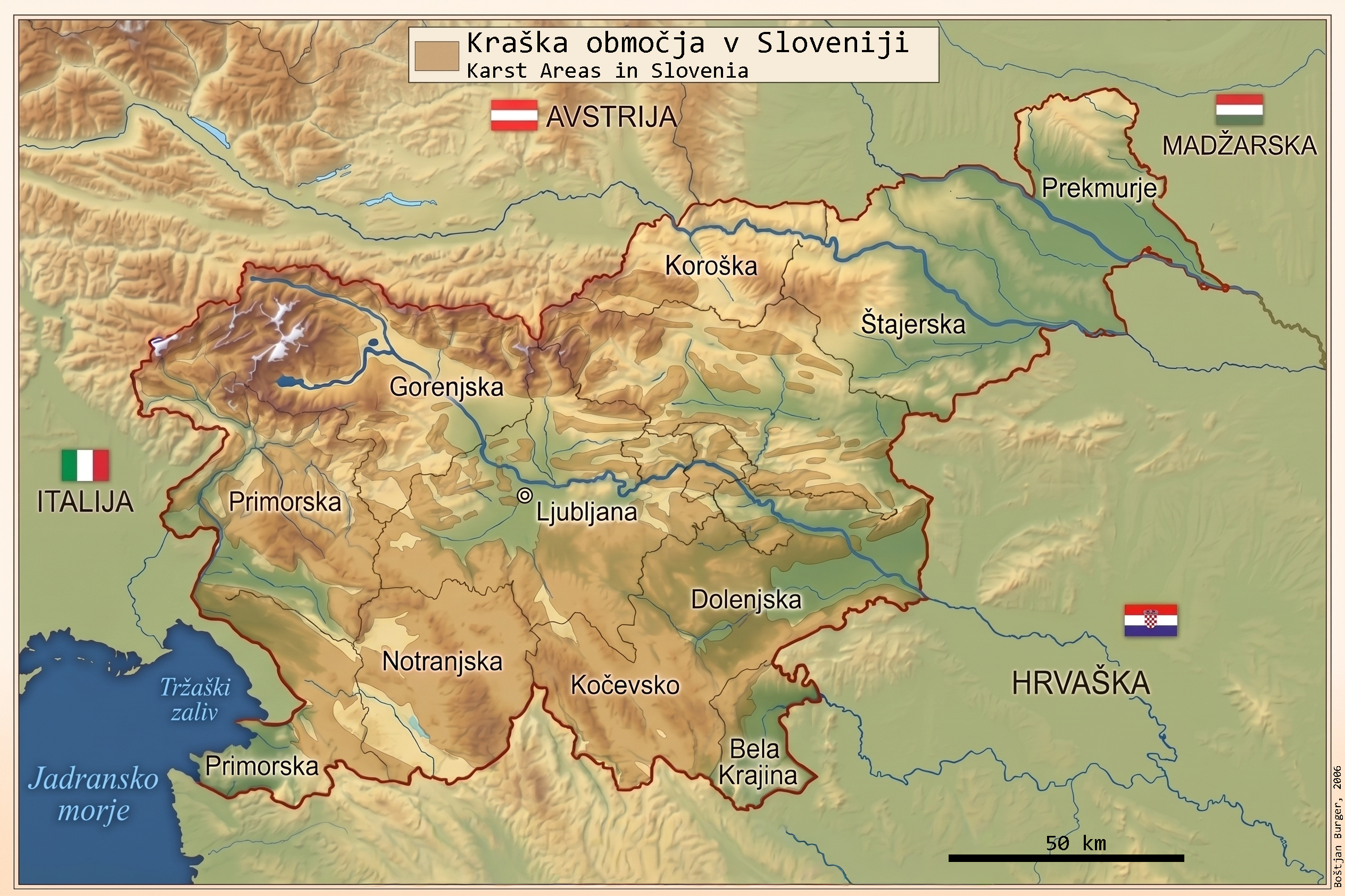
Geo-x: Specialized Karstology Chapters
Visualization as a bridge between darkness and light
This is where the burger.si project comes in—one of the longest‑running and most extensive undertakings to visually open Slovenia’s subterranean world. Through a combination of photography, 360° panoramas, 3D models, virtual reconstructions, interactive presentations, and documentary descriptions, the project breaks the dark barrier separating the public from the underground realm. The technologies you have been developing and refining since 1993 make possible what was unimaginable only decades ago: to make caves accessible even to those who cannot visit them physically—researchers, students, tourists, decision‑makers, conservationists, and all who wish to understand how the karst world functions.
Visualization is not merely depiction. It is interpretation—a translation from absolute darkness into comprehensible light. It is the means by which underground space acquires form, scale, context, and narrative. It is documentation that preserves the state of caves through time, records changes, enables comparisons, and lays the groundwork for future research. It is also a cultural record—a testimony to how humankind enters a space shaped entirely without it.
author: Boštjan Burger
