STAGE 6 (Saint-Jean-Pied-de-Port → Kaskoleta, 17 km)
At morning dusk, I passed through the town walls beneath the fortress and left the pilgrimage center of Saint-Jean-Pied-de-Port. I continued the trek southeast along a local asphalt road toward the village of Caro. Below in the valley, morning mist was coiling, and the sky was covered with thick clouds. The humidity was at 100%, so right from the start, I was already soaked from both sweat and a light drizzle.
On the road, I caught up with Ron, a hiker from Alsace who, besides French, only spoke German. We continued our conversation in German while following the GR10 signs. The village of Caro was a typical Basque settlement with white facades and characteristic stone cornerstones. Like literally every Basque village, it had a court for Basque Pelota, which is similar to squash. The "Fronton"—a court with high U-shaped walls that serve as rebound surfaces for the ball—is hard to miss. Many pelota games are also played on courts with just one or two walls.
Basque Pelota is the name for various court games played with a ball using one's hand, a racket, a wooden bat, or a basket, against a wall (frontis or fronton) or, more traditionally, between two teams face-to-face, separated by a line on the ground or a net. The roots of these games can be traced back to Greek and other ancient cultures. The term "pelota" likely comes from the Vulgar Latin term *pilotta* (ball game), a diminutive of *pila*, which refers to a hard linen or leather ball filled with *pilus* (fur or hair). It is also related to the English word *pellet*.
Pelota is primarily played in the Basque regions of southwestern France and northwestern Spain, where it originated. Due to the game's origins, many top players are Basques, either locals or from the Basque diaspora.
From Caro, the path continued through the rolling Basque hilly landscape. The hike would have been very pleasant if not for the low clouds, humidity, and occasional drizzle. Near Gattare Hill (761 m), I encountered a fenced and managed carrion site for Griffon vultures (*Gyps fulvus*) for the first time. They are scavengers and, like other vultures, feed mainly on the carcasses of dead animals.
Griffon vultures measure 95–110 cm in length with a wingspan of 230–265 cm; an individual bird weighs 6 to 10 kg. They are social birds, living in colonies of up to two hundred. Theoretically, the bird isn't massive, but when it flies over a hiker, it feels like a glider plane passing by. A few stages later, I witnessed in the wild how a colony of several dozen birds tore apart a cow killed by lightning, finishing it in about half an hour.
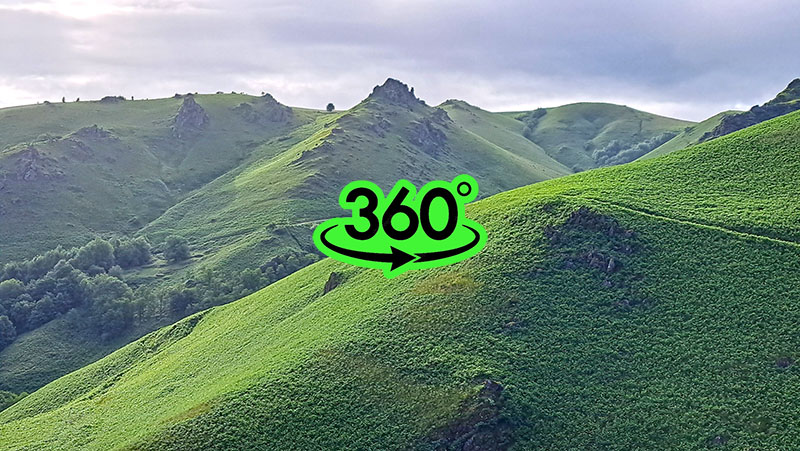
As mentioned, the GR10 trail is well-marked, but the route has changed over time—new sections or variants have been added. The old route led west of Gattare Hill, while the new one was extended by three kilometers to the east, bypassing the hill via a path with better views and natural rocks sticking out of the slopes like natural megaliths. Ron had stayed somewhere behind kilometers ago. Around one in the afternoon, I prepared lunch by a natural megalith on the slope and took a rest.
A steep descent to the village of Estérençuby followed. In the village, just before the next ascent, I came across an open tavern where, to my surprise, familiar travelers from previous days were waiting. Among them was Vincent, who explained that they had all chosen a shorter route that saved them about two hours of walking.
After a break, three of us from the group set off toward the end of the sixth stage—the Kaskoleta mountain refuge. This was followed by a nearly two-hour, 500-meter climb along a local winding road that took us past numerous sheep pastures to the shelter.
Due to the gloomy, cloudy weather and numerous climbs, I was quite tired. Since the beds in the hut were already taken and I prefer wild camping anyway, I said goodbye to Vincent and continued toward the seventh stage heading for the Chalet d'Iraty recreation center.