STAGE 5 (Saint-Étienne-de-Baïgorry → Saint-Jean-Pied-de-Port, 20 km)
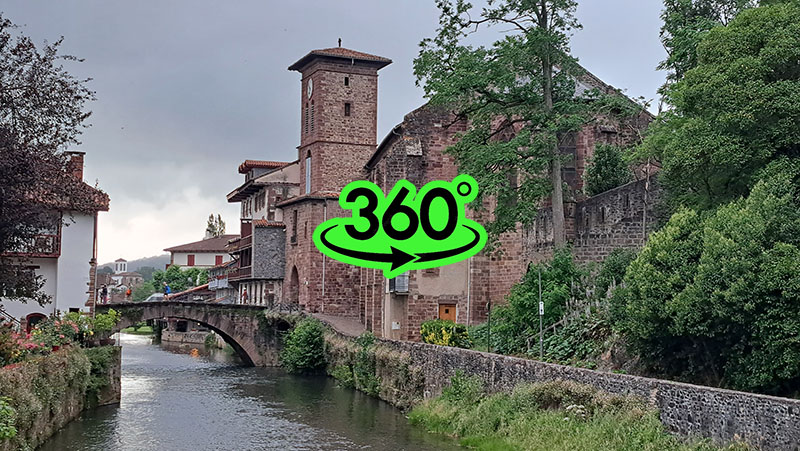
At six in the morning, while it was still dark, I packed my tent, had breakfast, and set off from Saint-Étienne-de-Baïgorry heading south. Still within the settlement, I crossed the Nive des Aldudes river via a bridge and began the steep ascent up the slopes of Oilarandol (933 m). I caught up with a French hiker named Mario, who was walking at roughly the same pace. While I was busy documenting the landscape with spatial images, Mario was fascinated by orchids, stopping frequently to photograph them with great enthusiasm. I personally don't know much about orchids—only that they occasionally appear at our home as gifts and decorate the place for a few weeks—so it was interesting to talk to someone who spoke of them with such passion.
It was another stable day weather-wise, meaning I wasn't soaked by rain, but it was extremely humid. The sweat was pouring off me. I ran out of water quickly, but there were strong springs of fresh water along the path. However, due to the high-altitude pastures, I didn't want to take any risks and used chlorine purification tablets. It's all well and good, but drinking water that tastes like chlorine is quite unpleasant, so I enriched it with a sachet of orange-flavored magnesium, which made it tolerable.
The path along the contours of the fern-covered slopes around Oilarandol was picturesque and not too taxing—practically level walking. By this fifth day, I no longer felt my heavy backpack as a burden; I had finally gotten used to the weight. After two hours, Mario and I cooked lunch at the Col d'Urdanzia (869 m). Mario discovered more orchids, while I continued toward Mount Munhua (1021 m), where Vincent, traveling light, eventually caught up with me. He praised my pace, as he had expected to reach me much earlier.
From Mount Munhua, the trail led downward toward the end of the fifth stage, Saint-Jean-Pied-de-Port. I successfully kept up with Vincent while documenting the route. Along the way, Vincent explained the history of the town that was our daily destination.
Saint-Jean-Pied-de-Port (Donibane Garazi in Basque) is the ancient capital of the traditional Basque province of Lower Navarre. It is also the starting point for the French portion of the famous Camino de Santiago pilgrimage route. The town sits on the Nive river, 8 km from the Spanish border. In 2016, it was ranked among the most beautiful villages in France. The old town center essentially consists of one main street lined with souvenir shops related to the Camino, pilgrim hostels, and restaurants.
As Vincent and I arrived, a storm began to brew, so we headed to our respective accommodations and agreed to meet later for a proper Basque dinner. Vincent had a room booked at a guesthouse, while I went to the nearby 'municipal' campsite, quickly pitched my tent, and enjoyed a long, hot shower. One advantage of carrying an umbrella was that I could stroll through the town during the rain and explore its sights. Despite the many travelers—mostly pilgrims—the atmosphere was relaxed.
I had set out with very little cash, counting on my payment card. The problem in the Basque Country—or at least along the trails I walked—is that most guesthouses and shops do not accept cards (why pay bank fees?) or limit their use to amounts over fifteen euros. This was the case in Saint-Jean-Pied-de-Port as well. I started to worry about future payments if such a large settlement didn't allow convenient card use. I went on a literal "treasure hunt" for an ATM. Using ATMs is not as straightforward as in Slovenia; alternatively, one can withdraw cash at a bank with a fee, provided the bank is open...
Toward evening, Vincent called to say he had found a good restaurant. And he certainly did. I found myself facing a massive, double oval plate of thinly sliced roasted meat—I am not exaggerating when I say the portion must have been a kilogram. Accompanied by vegetables and fries, it was everything one could crave after five days of dehydrated meals. Usually, I don't eat meat and am practically a vegetarian, but when I'm on the trail, I know I need protein, so I set aside my principles for what is available.
Our dinner was long, and a fierce storm with strong winds raged outside, making me worry if my tent would survive. We talked about life, reflected on the GR10, and wondered where the path would lead next. Time flew by. When we parted, the night was dark. My tent was intact and dry inside. I brushed my teeth and literally "turned off" inside my fluffy down sleeping bag as the air cooled down.