STAGE 4 (Bidarray → Saint-Étienne-de-Baïgorry, 16 km)
In the only available shelter in Bidarray—the foyer of the public toilets—I waited for the storm to subside, but this time it seemed endless. After two hours of waiting, it was still raining heavily. During a brief lull, I hurried to the small shop that opened at 4 PM. Since the rain wouldn't stop, I changed into my poncho, opened my umbrella, and set off on the fourth stage. The path out of the village immediately turned into a steep, muddy trail that had already transformed into a murky stream I had to wade through. I regretted starting so soon, but I persevered and continued the climb. I was caught by hail again, then rain, and hail once more. Full of sarcasm, I thought to myself... ideal!
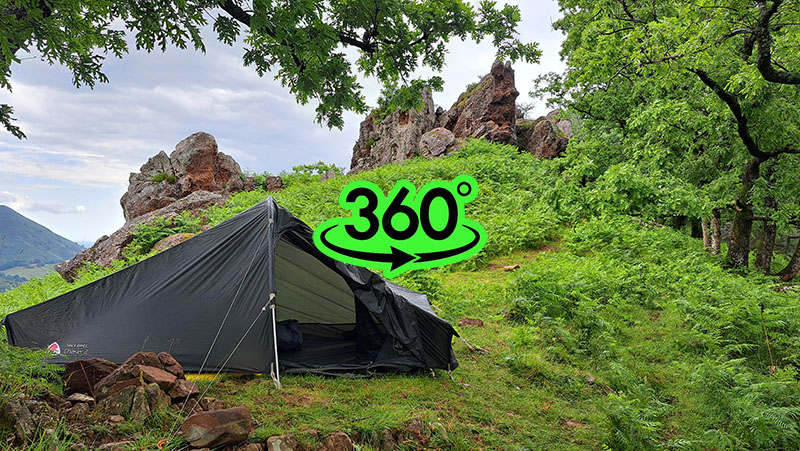
After about an hour of climbing, the storm tapered off and sunbeams peeked through the clouds. Having had enough of splashing through the mud, I decided to find a suitable place to pitch my tent. The slope was steep with no level ground in sight, but then, around a bend, a mountain saddle appeared between two peaks with a small clearing. I set up my tent. Nearby was the rocky summit of a small hill with a faint path leading to it. After pitching the tent, I curiously followed it and discovered rock shelters (abris) where something must have happened in the past; they either served as shepherd shelters or held religious significance, as the surrounding rocks reminded me of deliberately placed megaliths.
I slept like a log and woke to a beautiful sunrise. The morning was cloudless, and the day began promisingly. I skipped breakfast at the camp, intending to have it higher up at a more scenic location. And the views that day were indeed magnificent. Beautiful sunny weather and panoramic viewpoints along a long ridge. I diligently documented the path with 360° spatial images, and after two hours of walking, just below Pic d'Iparia (1044 m), I treated myself to a hot meal. This was also the first thousand-meter peak conquered since leaving Hendaye. Here, Vincent caught up with me after we had parted ways in Ainhoa. Because I was taking advantage of the fine weather and views to document the landscape, I was too slow for him, and he hurried ahead with his much lighter pack.
This fourth stage between Bidarray and Saint-Étienne-de-Baïgorry was relatively long—only 16 kilometers, but the estimated non-stop walking time was over six hours. In reality, given my documentation pace, I had to add at least fifty percent to that timeline. I had been warned that access to drinking water would be very limited on this stage; having consumed three liters before even reaching the halfway point, I began searching for springs. My first opportunity to refill came only after descending from Mount Buztanzelhay (1029 m). After crossing the Col de Buztanzelhay and starting the descent into the valley, I found numerous small springs fueled by the recent heavy rains merging into a stream. I filled my bottles and added disinfection tablets.
The day grew increasingly hot. By the time I reached Saint-Étienne-de-Baïgorry after two more hours of walking, the temperature had reached 32°C and my water bottles were empty again. After the previous cold days, the sudden heat spike made hiking quite strenuous. In the center of the village, a guesthouse was open where I met fellow hikers I had seen on the trail in previous days. The heat made us all lazy, and most of us decided to end the day's hike there. North of the village is a well-maintained campsite where I washed and dried my mud-soaked clothes. The first hot shower after four days of hiking from Hendaye felt incredible.
The day transitioned into a warm evening. An Englishman named Denis pitched his tent nearby. He was around my age and had hiked the Spanish side of the Pyrenees (the GR11) in previous years; now he had decided to tackle the French side. We spent the evening in an English-Slovenian chat about hiking experiences before sinking into a tired sleep.