STAGE 2 (Olhette → Ainhoa, 21 km)
A new storm wave was approaching from the Atlantic, so we bypassed the settlement and turned up a steep slope to begin the second stage toward the village of Ainhoa. The wet and humid weather had already exhausted us. It was late afternoon, and we were already scouting for a suitable place to pitch our tents. The slope was steep, and we "gnawed at our knees" for over an hour before reaching a suitable level area. The first drops of rain caught us just as the tents were being pitched—barely ahead of the storm. The storm passed quickly, and the setting sun broke through the clouds. We prepared dinner, talked with Pauline about life, she translated for her father, and then we collapsed into our tents... another storm was approaching, lulling us into a weary sleep.
During the night, I was woken up by one of the Samoyeds licking the tent out of thirst. Checking my watch, I realized it was actually already morning, just past six. Back home in Slovenia, it is broad daylight at six in the morning at this time of year, but here the sunrise is delayed by more than an hour. Since I usually wake up before five, I was already wide awake. I prepared a warm breakfast, packed my tent, and since Pauline and her father were still sleeping, I set off quietly. I assumed they would catch up with me along the way, as I was walking at a "working pace," capturing the surroundings using the 360° spatial imaging method. Little did I know that I wouldn't see Pauline and her father Max again...
I set off at sunrise, and from the direction of the sea, a new storm wave was already approaching like a thick curtain. The morning sun shone through it, creating a truly beautiful, fairytale-like rainbow.
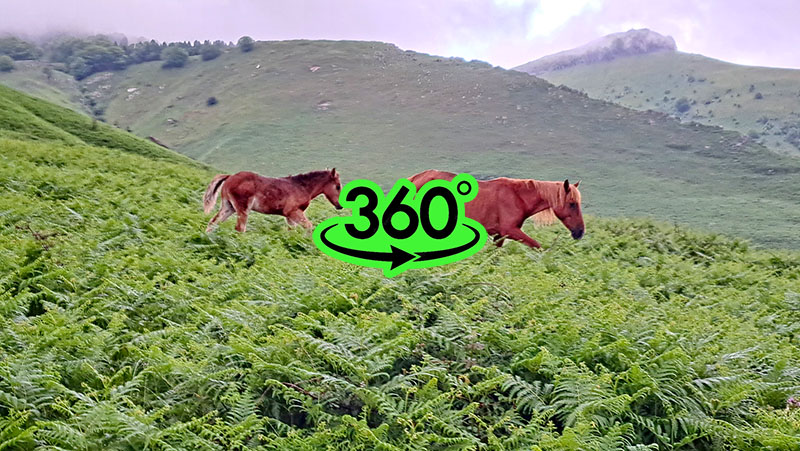
The slopes of the hills here are overgrown with ferns, where horses graze. Along the path, there were many pregnant mares or mares with small foals. Early morning brought my first experience of witnessing a birth. Not far from the path, I saw a mare panting, and then she gave birth to a foal, which was already stepping around its mother after only a few minutes.
The peak of La Rhune (905 m) peeked out of the fog, indicating the direction toward the Col des Trois Fontaines pass (563 m). A rack railway leads to La Rhune, which is considered the first serious mountain on the way from Hendaye. At the summit, besides a communication tower, there are restaurants and souvenir shops, as La Rhune is a landmark of the Basque countryside. In good weather, the summit offers a beautiful panoramic view of the Basque region, stretching from high mountain peaks to the Atlantic Ocean.
I overcame the temptation to visit the summit as I ascended the pass into thick fog and light rain, which soon escalated into a heavy downpour. Wave after wave of rain followed by drizzle made for quite exhausting walking. After Col des Trois Fontaines, I crossed the rack railway and began descending into the valley toward the village of Sare along a slippery and muddy path. In Sare, I had a snack and then set off toward the village of Ainhoa along local roads and tracks. The rain did not stop; it intensified. I navigated past numerous puddles on the cart tracks, avoiding mud traps. The poor weather probably contributed to the fact that I hadn't met any hikers that day, so I was surprised when a hiker caught up with me, carrying a wide smile and a far-reaching positive energy. We continued the journey together and struck up a conversation. Vincent, as he was named, was from Biarritz and had decided to hike the first half of the GR10 from Hendaye to Bagnères-de-Luchon. As a freelance industrial designer, he needed a break and chose the challenge of hiking part of the GR10. He chose a completely different travel tactic: he had booked all his accommodations in advance, thus saving himself many kilograms of load. To me, this tactic seemed less relaxing, as one would have to keep a pace exactly according to dates regardless of the weather, or the reservation system would collapse. I preferred carrying a tent with a sleeping system and a weekly supply of food, pitching the tent whenever I found a suitable spot.
Vincent knew Ainhoa, the end of the second stage, and before we arrived, he taught me about the history and significance of the settlement. Our conversation about the town began when I mentioned how much I would enjoy a good fruit yogurt and how I would buy it at a shop in the village. Vincent smiled and said that Ainhoa, despite having more than 600 inhabitants, has no shop. Ainhoa is an old settlement with written mentions dating back to the 13th century and still has a well-preserved town center, maintained today by strict regulations on building dimensions and permitted activities, featuring characteristic white facades. The Church of the Assumption from the 13th century is listed in the cultural heritage register of France, and the village itself is on the list of the most beautiful villages in France.
Upon arriving in Ainhoa, the rain eased slightly. Vincent and I sat in a restaurant garden in the center and treated ourselves to refreshing fruit juices mixed with mineral water.