STAGE 1 (Hendaye → Olhette, 21 km)
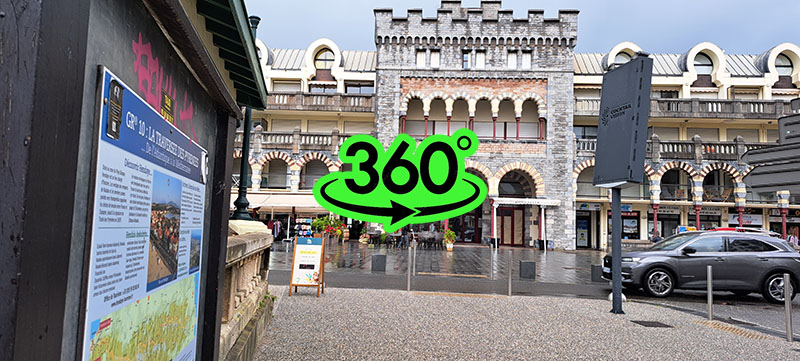
Despite it being Sunday, the shops in Hendaye were open, which is quite unusual for this part of France. Although I intended to start my GR10 journey on Monday, I decided to walk a few kilometers already on Sunday to the first major settlement from Hendaye. It took me an hour to reach Biriatou, walking without a heavy backpack. The route started from the beach in Hendaye, past the old casino built at the end of the 19th century—which now houses restaurants and small souvenir shops—through the main street, Boulevard du General Leclerc, and then right towards the Txingudi Bay, which separates French Hendaye from Spanish Irun. Txingudi Bay is the estuary of the 66 km long Bidasoa River into the Bay of Biscay. The path follows the promenade along the bay and then turns through the residential area of Hendaye toward the southeast, beginning a gradual ascent towards Biriatou. The GR10 trail is well-marked; one only needs to follow the red and white blazes.
The path toward Biriatou was muddy and full of puddles due to previous heavy rain. The light rain during my walk escalated back into a heavy storm, so I turned back and headed to my guesthouse (gite). I arrived muddy and soaked on the very first day, even though I was wearing shoes labeled as 'waterproof'. Only tall rubber boots would have been a match for several hours of walking in heavy downpours along muddy tracks and paths.
On Sunday evening, I checked the weather forecast. It didn't predict extreme conditions, but rain was forecasted for the following week.
The hike had to begin, so on Monday morning, I set off on foot, fully loaded, toward Hendaye. I continued toward the Decathlon sports store, which didn't open until 9:00 AM, to purchase a gas canister for my stove. Now carrying my full gear, I repeated Sunday's route toward Biriatou. The morning drizzle turned into late-morning sun, shining through the still-dense clouds.
Unburdened by the rain, I focused on observing the Basque rural architecture. Neat houses, all built in the same style with white facades and embedded wooden beams painted in a reddish-brown color. There is no modern architecture here, as even the newly built houses follow the old 'historical' style.
Near the village of Biriatou, I caught up with my first hiking companions on the GR10. A father and daughter had decided to hike the entire GR10 trail in two months. Pauline brought her two Samoyed dogs, whose white coats stood out against the green Basque landscape. The 28-year-old, about 160 cm tall, bravely carried a 22-kilogram backpack with all her outdoor gear and food for the two dogs. Her father, a 60-year-old who looked closer to 50, had grown tired of his culinary career and took early retirement to enjoy life. Pauline, also a chef in the family restaurant, took two months off to think about "where to go next" and joined her father on the journey from the Atlantic to the Mediterranean.
Monday's introductory stage of the GR10 was accompanied by changeable, and above all, very "wet" weather, which became a constant theme for the following weeks of the trek. The first stage was also an introduction to the walking pace, which was "a little up" - "a little down." Psychologically demanding for those carrying heavy backpacks.
Rain came in stormy waves from the Atlantic, and the weather literally changed from minute to minute. While walking, I like to contemplate and focus on my thoughts, but I have nothing against conversations with fellow hikers. During my geography studies at university, a professor's thought stuck with me: a geographer's most powerful tool is talking to people in the field. I took the GR10 hike as a work project rather than just sport or recreation, so I naturally included this geographical tool - conversation. Although I have traveled extensively in France over the past thirty years, my French is still quite basic—I understand fundamental words and phrases but am not 'equipped' for a full conversation. Unfortunately, most French people, interestingly even younger generations in the internet age, do not use English, today's 'universal language'. Interestingly, in the following days, I found Italian and German to be the most helpful. Pauline, an interesting and, as mentioned, brave girl, knew enough English for a basic conversation, while her father spoke only French, so his daughter patiently translated our talks. We clicked well from the start, so we continued the journey together toward the end of the 21 km long first stage in the village of Olhette.