

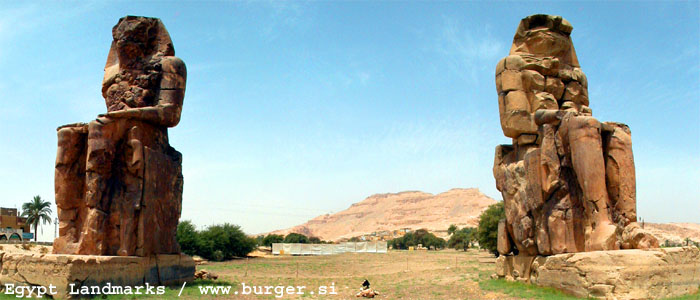
The Colossi of Memnon stand on the western bank of the Nile, on the broad plain between the river and the Theban hills, where the largest necropolis of ancient Egypt flourished during the New Kingdom. The pair of monumental statues, each approximately eighteen meters high, was erected around 1350 BCE as the guardian figures at the entrance to the mortuary temple of Pharaoh Amenhotep III, once the largest temple complex in Thebes. They are carved from quartzite sandstone quarried north of Cairo and transported hundreds of kilometers southward, a feat that itself testifies to the extraordinary organization and technical skill of the Egyptian state in the 18th Dynasty.
The statues depict the pharaoh seated with his hands resting on his knees, and at his legs stand the smaller figures of his wife Tiye and his mother Mutemwije. Reliefs on the sides show the god Hapi, symbol of the Nile and its fertility. Behind the colossi stretched the vast temple complex, which, due to its size and location, was exposed to centuries of flooding, erosion, and several earthquakes. Today it survives only in fragments, while the colossi still stand in their original position.
The northern colossus became famous in the Roman period as the “singing Memnon.” After an earthquake in 27 BCE, the damaged stone began to emit metallic, resonant sounds at sunrise, which Greeks and Romans interpreted as prophetic singing. They associated the statue with Memnon, the Ethiopian hero of the Iliad, son of the dawn goddess Eos, whose voice was believed to rise with the first light. Roman travelers, including Emperor Hadrian, left more than a hundred inscriptions on the pedestal describing the phenomenon. When the Romans restored the statue in the 2nd century CE, the “singing” ceased.
Today the Colossi of Memnon stand as the mighty remnants of a lost temple, as a geographical and historical landmark of the Theban landscape, and as a symbol of Egypt’s layered heritage, where architecture, mythology, natural forces, and the fascination of the ancient world intertwine.
April 2004