
Speleothems (Secondary Mineral Deposits in Karstology)
Speleothems (from the Greek spēlaion – cave and théma – deposit) are secondary mineral deposits formed in natural subterranean cavities through the chemical precipitation of minerals from dripping, flowing, seeping, or pooled cave waters. Colloquially, speleothems are often loosely referred to simply as cave formations or dripstones; however, the scientific karstological term speleothem is much broader, encompassing not only vertical dripstones but also flowstones, rimstone dams, curtains or draperies, cave pearls, helictites, and delicate crystalline aggregates such as aragonite anthodites.
1. Chemistry and Formation Mechanism of Speleothems
Meteoric water percolating through the soil mantle and overlying carbonate bedrock absorbs soil carbon dioxide (CO2) generated by root respiration and microbial decay. This creates a dilute carbonic acid (H2CO3) solution that actively dissolves limestone and converts it into soluble calcium bicarbonate:
CaCO3 + H2O + CO2 ↔ Ca2+ + 2HCO3−
When this saturated solution reaches an open cave chamber, where the partial pressure of CO2 in the cave atmosphere is markedly lower than in the overlying soil, rapid degassing of CO2 occurs (the gas escapes from the aqueous solution into the cave air). The disturbed chemical equilibrium shifts toward the precipitation of solid calcium carbonate (CaCO3), which crystallizes out as spelean sinter:
Ca2+ + 2HCO3− → CaCO3↓ + H2O + CO2↑
By far the most common mineral in speleothems is calcite (the trigonal polymorph of CaCO3). Under specialized conditions—specifically when the water contains dissolved magnesium ions (Mg2+, which inhibit calcite nucleation) or where air currents accelerate evaporation—calcite growth is suppressed in favor of its orthorhombic, acicular polymorph: aragonite. In anhydrite- and sulfate-bearing cave cavities, gypsum (CaSO4 · 2H2O) precipitates as well.
2. Morphological Classification and Types of Speleothems
Karstology classifies speleothems into distinct genetic and morphological groups based on water flow dynamics and physical growth mechanisms:
-
Dripstone Formations (Gravitational / Dripping Water):
Soda straws (tubular stalactites): The earliest growth stage of a stalactite. They are thin, hollow, cylindrical tubes with the diameter of an average water drop (~5 mm). Water flows through the central feeding canal, and calcite is deposited exclusively along the annular rim at the tip.
Stalactites: Downward-pointing conical formations hanging from the cave ceiling. They develop when the internal bore of a soda straw becomes occluded, forcing water to flow down the exterior flanks and thickening the deposit into concentric layers.
Stalagmites: Upward-growing formations rising from the cave floor where drops strike from above. Unlike stalactites, they lack an internal tube; they are solid structures with flat, rounded, or candelabra-like profiles.
Columns (stalagnates): Massive vertical pillars produced when a descending stalactite and an ascending stalagmite coalesce into a single continuous structure.
-
Flowstone and Seepage Formations (Flowing and Seeping Water):
Draperies (curtains): Thin, wavy, and pleated translucent sheets that grow as thin water films trickle along inclined ceilings or overhanging walls. Fluctuations in trace iron and manganese oxides frequently impart parallel bands of color (famously termed "cave bacon").
Flowstone cascades and frozen waterfalls: Extensive sheets of calcite that coat steep walls and bedrock slopes beneath cascading or sheeting films of water.
Rimstone dams (gours): Stepped terraces of calcite basins formed on sloping floors. Calcite precipitates preferentially along the turbulent overflow rim due to enhanced CO2 loss, enabling the basin to build its own retaining barrier.
-
Eccentric Speleothems (Capillarity Dominating Gravity):
Helictites: Twisted, branching, and vermiform formations that defy gravity, growing in any three-dimensional direction. Capillary forces feed water through microscopic central canals, while directional shifts are governed by crystal axis twinning and subtle air currents.
Heligmites: Analogous erratic, curlicue formations that sprout upward and laterally from the cave floor.
-
Aragonite Formations and Anthodites:
Do aragonite anthodites qualify as speleothems? Yes, unequivocally. Although they exhibit radiating crystalline habits rather than classic dripstone silhouettes, they are secondary mineral formations precipitated from subterranean aqueous solutions, satisfying the rigorous karstological definition of a speleothem.
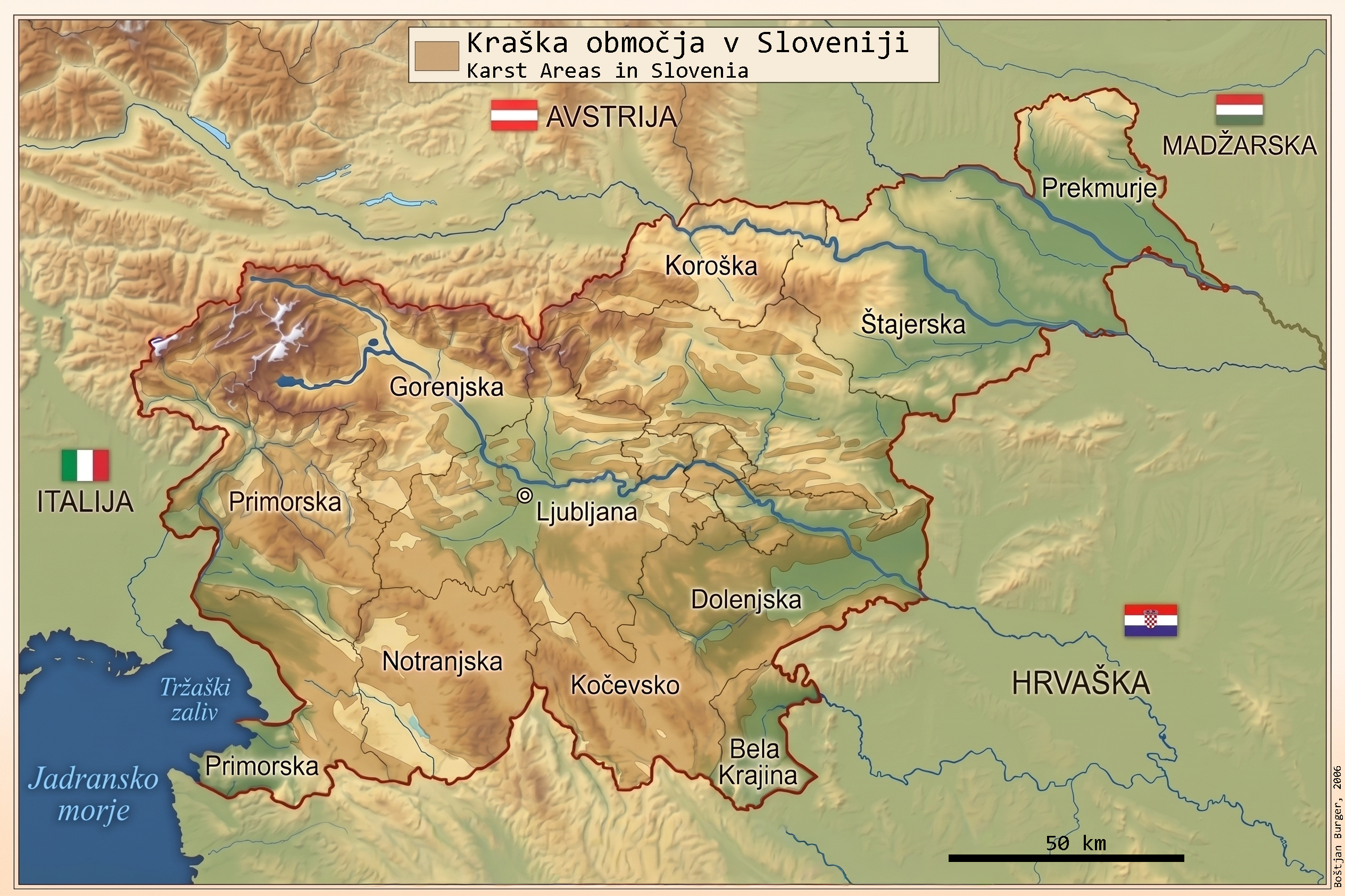
Aragonite anthodites (frostwork / sea urchin forms): Radiating clusters of pristine white, needle-like aragonite crystals fanning out from a central locus on cave walls or ceilings, resembling spiky frostwork or crystalline sea urchins (characteristic of aragonite-bearing chambers, such as in Ravbarska Cave and Pečovnik Caves).
-
Pool Formations and Bio-Speleothems (Standing Water & Microorganisms):
Cave pearls (pisoliths): Spheroidal concentrations of calcite layered concentrically around a core grain (such as sand or limestone fragments) within shallow rimstone pools; agitation from dropping water keeps them rotating and prevents them from adhering to the pool bed.
Moonmilk (montmilch): A soft, plastic or chalky white paste consisting of microcrystalline calcite or hydromagnesite with high water content, commonly precipitated with the assistance of microbial colonies.
Cave popcorn (coralloids): Nodular, knobby, or botryoidal clusters formed on cave surfaces by water splashing or the evaporation of diffuse capillary moisture.