

St. Nicholas Church
The Church of St. Nicholas on Gora stands proudly on a scenic hill above the village of Gradišče, overlooking the picturesque Tuhinj Valley. Its elevated position is far from accidental: this tranquil, forest‑embraced ridge has served as a spiritual center for many centuries. Today, the church is not only a place of worship but also a remarkable monument of cultural heritage, preserving within its walls the architectural and historical layers of different eras.
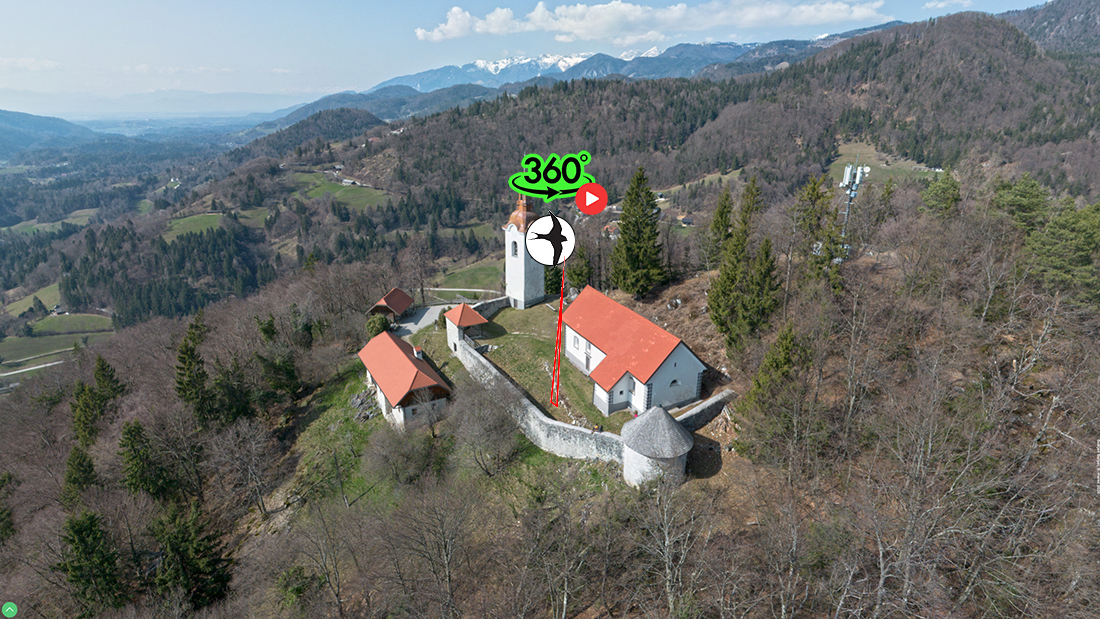
The church’s present form dates back to the early 18th century, when it underwent extensive reconstruction between 1721 and 1730. Although its original layout was Gothic, later interventions introduced strong Baroque influences that shaped its current appearance. During this major renovation, the nave was enlarged and heightened, a vaulted presbytery was added, and a sacristy was built, giving the interior a sense of spaciousness and light. As a result, the church today represents a harmonious blend of Gothic restraint and Baroque richness.
One of the most striking features of the interior is the coffered wooden ceiling, meticulously restored over seven years by the Restoration Centre of Ljubljana and completed in 2004. The ceiling paintings, particularly the depictions of St. Matthew and St. Nicholas, lend the space warmth and artistic depth, showcasing the skill of Baroque craftsmen who seamlessly combined architecture, painting, and symbolism.
The main altar holds a special place in the church’s artistic heritage. Created in 1741 by the workshop of Gaber Bergant from Kamnik, it is an exquisite Baroque wooden masterpiece. It is adorned with an oil painting of St. Nicholas by the renowned Baroque painter Valentin Metzinger. The painting was restored as early as 1920 and, due to its artistic significance, exhibited in Paris around 1990. Alongside the main altar, the interior is enriched by additional altars whose paintings and architectural elements further enhance the Baroque narrative. The side altars on the inner walls of the presbytery are fine examples of mid‑18th‑century Baroque illusionism, while the northern wall features the altar of St. Francis Xavier, decorated with a 1724 painting by the artist Jelovšek.
The history of the church, however, reaches much deeper into the past. Archaeological excavations carried out at the end of the 20th century revealed the foundations of two earlier churches on the same site. One was a Gothic church from the 13th century, while the other was an even older Romanesque structure, built between the years 500 and 600 AD. These discoveries confirm that Gora has been an important sacred site for more than a millennium, possibly even longer, serving successive religious communities without interruption.
The church has also endured its share of hardships. During the Second World War, it suffered partial damage when German forces destroyed part of the roof tiles. Nevertheless, the local community ensured that the building was repaired and preserved in its architectural integrity. Today, it remains an active branch church of the Parish of Šmartno v Tuhinju, hosting regular masses and continuing to serve as a symbol of identity and unity for the local people.
Next to the church stands the modest sexton’s house, or mežnarija, which has retained its original architectural and ethnological character. It still contains a functioning black kitchen, a rare surviving example of traditional rural life in Slovenia. First mentioned in written sources in 1723, the house has always been closely connected to the functioning of the church and has been lovingly maintained by the local community throughout the centuries.
The Church of St. Nicholas on Gora thus remains a place where history, art, spirituality, and local tradition intertwine. Its silhouette above the valley is a lasting reminder of the resilience of cultural heritage and the enduring bond between the sacred space and the people who preserve it.