

The Zadnjica Valley, referred to as Zajenca in older sources, is an approximately four‑kilometre‑long high‑alpine glacial valley in the upper part of Trenta, situated in the central Julian Alps and entirely encompassed by the protective regime of Triglav National Park. Morphologically it is a pronounced U‑shaped valley carved by a substantial glacier during the last glacial phase, which is reflected in its broad, gently rising floor and in the steep, almost vertical slopes that enclose it. To the north the valley is closed by the walls of Kanjavec and Pihavec, to the east it is dominated by the massive ridge of Zadnjiški Ozebnik, while to the south and west the relief opens toward lower Trenta. This natural amphitheatre creates a distinct microclimate in which cold air currents descending from snowfields interact with warmer influences from the Soča Valley.
Geologically, the area is composed of thick sequences of Upper Triassic limestone and dolomite, which, due to intense tectonic deformation, are heavily fractured and intersected by faults and karstified fissures. This combination of massive carbonate rocks and strong tectonic disintegration produces hydrogeological conditions in which precipitation and meltwater rapidly infiltrate the subsurface and circulate through a complex network of fractured and partially enlarged karst channels. In the lower part of the valley, this underground water converges into the Krajcarica stream, a typical torrential watercourse with highly variable discharge depending on seasonal snowmelt and intense rainfall.
The most striking hydrological phenomenon in Zadnjica is the series of intermittent karst springs and waterfalls beneath Zadnjiški Ozebnik. After periods of heavy precipitation or rapid snowmelt, powerful karst “bruhalniki” emerge from beneath its vertical walls, where water literally bursts to the surface. The mechanism behind this phenomenon is linked to the filling of subsurface reservoirs and channels that function as a closed system: once the water level rises to the threshold where a conduit approaches the surface, pressure within the system increases to the point that water suddenly erupts from the fissure. The resulting waterfalls are short‑lived but highly dynamic; water cascades over smooth limestone steps in multiple tiers, often forming fan‑shaped jets that disperse into mist upon striking the rock. Because the underground system drains rapidly, these waterfalls typically persist only for hours or days before the springs fall silent again. This is one of the most vivid examples of high‑mountain karst outflow in Slovenia.
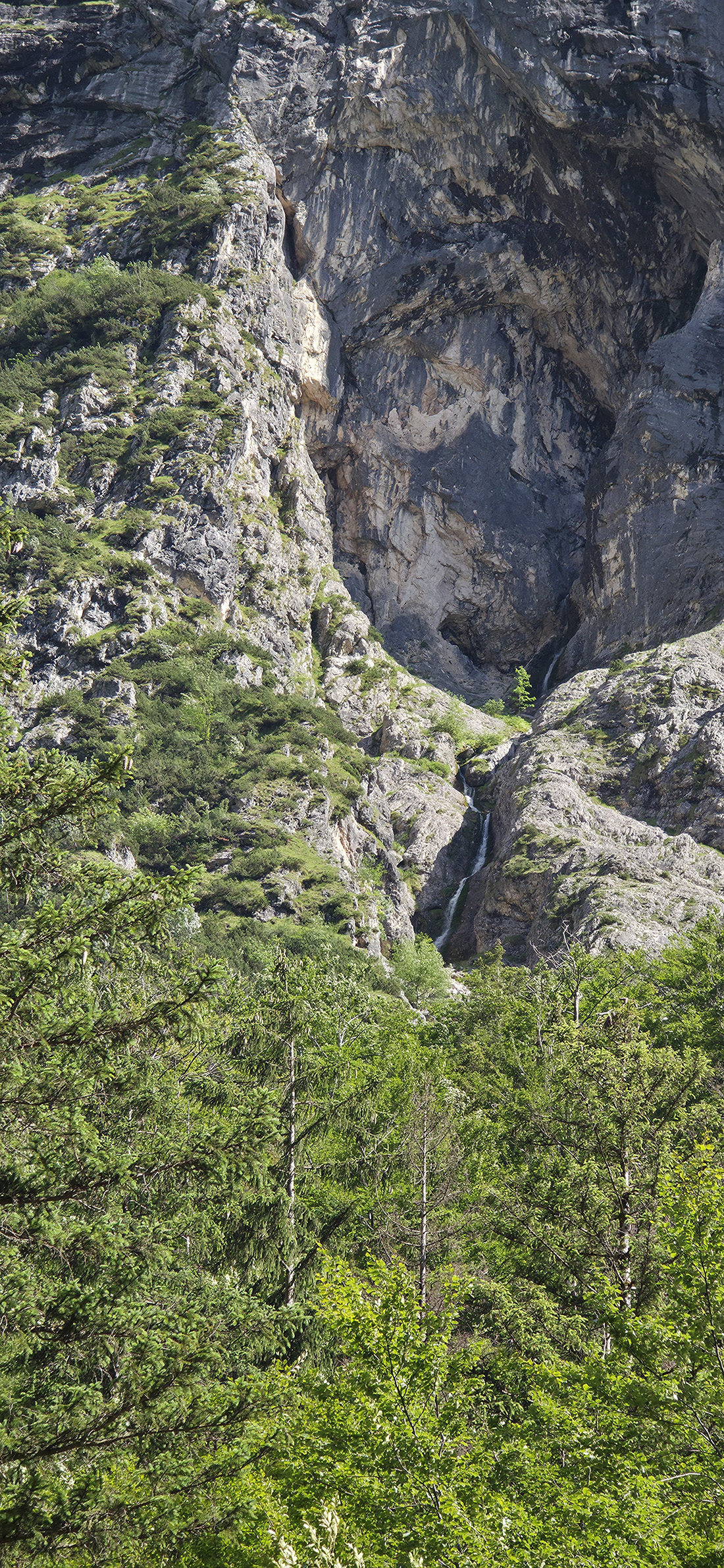
Historically, Zadnjica served as an important pastoral area, as evidenced by the remains of mountain huts, stone enclosures and terraced meadows. Despite this, the valley has preserved an exceptional degree of natural integrity, since traditional land use never developed into intensive economic exploitation. Today its significance is primarily mountaineering and conservation‑oriented. From Zadnjica lead several key high‑mountain routes toward the Kriški podi plateau, Prehodavci, Dolič, Kanjavec and further toward Triglav, making the valley one of the most important access corridors for traversing the central ridge of the Julian Alps. At the same time, due to restricted traffic, the absence of intrusive tourist infrastructure and strict protection measures, the valley has retained remarkable biodiversity. It hosts habitat types characteristic of cold torrential systems, scree‑slope ecosystems, high‑alpine forests and extensive quiet zones for wildlife such as chamois, Alpine ibex, rock ptarmigan and golden eagle.
Zadnjica thus represents an exceptional natural whole in which the geomorphological legacy of glacial processes, the karst dynamics of the high‑mountain carbonate world and the preserved cultural landscape of former pastures converge. Owing to its natural integrity, hydrological distinctiveness and position in the heart of Triglav National Park, the valley is one of the most valuable natural laboratories for understanding high‑mountain geomorphological and hydrogeological processes in Slovenia.