

Ajdovski Gradec near Vranje is one of the most important Late Antique archaeological sites in Slovenia. It lies on a 436‑meter‑high hill above the valley of the Vranje stream, about eight kilometers northwest of Sevnica. Because of its location on a naturally protected hill, it was strategically chosen during the time of the great migrations as a safe refuge for Romanized inhabitants who were fleeing from barbarian invasions.
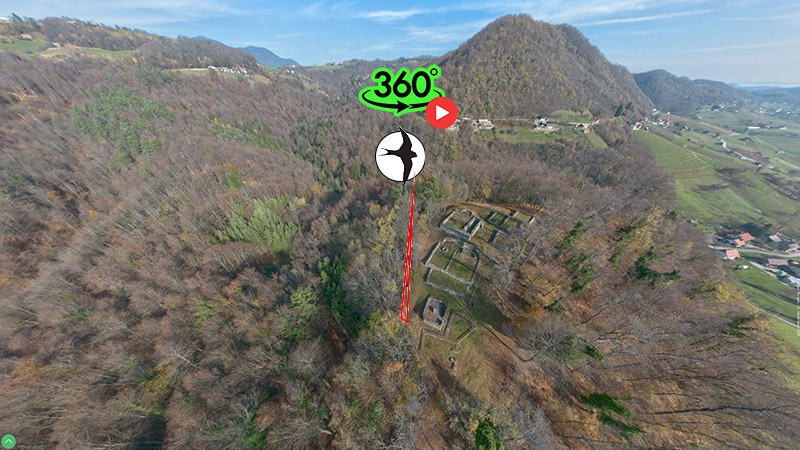
The first traces of settlement date back to the Late Bronze Age, but the site reached its peak in the Late Roman period, between the 4th and 6th centuries. At that time, Ajdovski Gradec was a fortified settlement with walls, houses, and churches. The site is also significant as one of the oldest early Christian centers in Slovenia, since archaeologists discovered as many as three churches, indicating a strong religious life within the community.
The settlement covered approximately 2 hectares, which was quite extensive for a hilltop settlement of that period. Based on the size and number of buildings, experts estimate that between 300 and 500 inhabitants lived at Ajdovski Gradec. This was a community of Romanized natives who, during the migrations of peoples, represented one of the larger early Christian centers in the Alpine and Danube regions.
The first archaeological finds were discovered by locals as early as 1811, when they came across a Roman tombstone and sarcophagus. Systematic excavations took place at the beginning of the 20th century, and later in the 1970s under the leadership of Peter Petru (1930–1983). Today, the hilltop reveals the foundations of houses, churches, walls, and fortified gates, while the finds are preserved in the National Museum of Slovenia in Ljubljana and in the museum in Graz.
Ajdovski Gradec is now arranged as an archaeological park, offering visitors a walk through history. A marked trail leads to the top through the forest above the village of Vranje, and at the foot stands the "Muca Copatarica" hut, a popular stop for hikers and families. In addition to viewing the ruins, guided tours and workshops are available to bring life in Late Antiquity closer to visitors.
The end of the settlement came in the second half of the 6th century, when the Slavs arrived in the region. Their arrival marked the final collapse of the Romanized community that had lived at Ajdovski Gradec and the abandonment of the early Christian center. The settlement was destroyed, and its inhabitants either dispersed or assimilated into new communities, marking the transition from Late Antiquity to the Early Middle Ages.
Ajdovski Gradec near Vranje thus represents the passage from the Roman to the early medieval period and the last herald of Roman civilization in Slovenia. Its heritage combines historical‑archaeological importance with modern excursion appeal, making it a valuable part of the Slovenian cultural landscape.
Comparison with Other Late Antique Settlements
Ajdna nad Potoki
- Location
- 1064 m, Karawanks
- Accessibility
- Difficult access
- Function
- Spiritual center
- Finds
- Jewelry, graves
Ajdovski gradec, Vranje
- Location
- Hill above Sevnica
- Accessibility
- Easier access
- Function
- Regional Christian center
- Finds
- 3 churches, baptistery
Rifnik near Šentjur
- Location
- Above Šentjur
- Accessibility
- Moderately demanding
- Function
- Religious/Admin center
- Finds
- Church inventory, graves
Tonovcov grad
- Location
- Above Soča River
- Accessibility
- Accessible from valley
- Function
- Center along traffic route
- Finds
- Mosaics, artifacts
Sources and Literature:
- Information boards at the archaeological site
- Peter Petru (1980): Depiction of a Scribe on the Relief from Ajdovski Gradec
- J. Dular et al. (1988–1993): Utrje and other proceedings