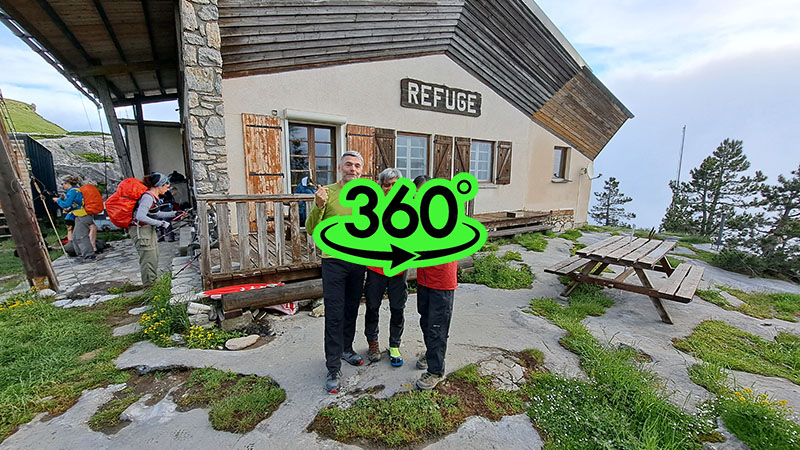
STAGE 11 (Refuge Jeandel → Lescun, 15 km)
Upon entering Refuge Jeandel, I first had to remove my boots and place my hiking poles in a small storage room with an emergency bunk. Stepping inside, I found a cozy, welcoming atmosphere; outside, the storm was already raging, and I felt safe.
The hut was built in 1963 by René Jeandel, a ski champion from the 1950s. It is situated at an altitude of 1,670 meters on a rocky peak, offering an exceptional panoramic view of various summits. Unfortunately, I had no luck with the view the next day either, as the surroundings were shrouded in thick fog.
A group of hikers awaited me at the hut, having decided to wait out the bad weather in safety. We were an interesting mix: a couple my age from Singapore, another from Canada, and a third from the Netherlands (it seems we 50-somethings are quite active in these adrenaline-fueled projects). There were also French, German, and Italian hikers...
The accommodation was very affordable: €45 including dinner and breakfast. At dinner, we sat at a long table and were served a very generous appetizer, main course, and dessert by the hut keepers. The meal was delicious and plentiful; no one left hungry. Breakfast was similar. Excellent service and high praise to the hosts.
After dinner, we engaged in conversations about our GR10 hiking experiences and exchanged tips. A long storm raged outside, and I couldn't imagine surviving such weather in a tent. A red weather warning had been issued, and we were worried about the path the next day, as only a brief break in the weather was forecast before another red warning in the coming days.
Morning arrived with a thick fog enveloping the landscape. After breakfast, I took a group 360° spatial photograph. As a group, we set off toward the GR10. Due to the fog, I turned on my satellite navigation, which showed a different path from the one the group was taking. I pointed this out, but the others had already bravely followed the GR10 signs. So, I continued alone. The path wound above the upper cable car stations of the ski center. The terrain was karstic, with deep sinkholes and depressions, and I found it hard to imagine safe skiing in this area—likely, warning signs are placed in winter. A wide stone track for snow groomers led me to the first GR10 sign, and since there wasn't a soul in sight, it dawned on me why... the other hikers had followed the signs but, in the thick fog, had gone back the way they came the previous day. The fog eventually lifted, and sunbeams began to break through, improving visibility to a few hundred meters. As a karstologist, I found the terrain fascinating and tried to document the landscape. Soon, the other hikers began to catch up, confirming my discovery of the wrong direction.
The hike continued over extensive ski slopes. A gentle ascent began through limestone pavements and other karst features of this region. Using cables and pegs, I climbed to the Pas de l'Oskue pass (1,922 m), where I experienced an alpine atmosphere similar to our Slovenian mountains. From the pass, I descended across scree slopes and past stone cairns into a leveled karst area. Here I met a group of Spanish mountaineers ascending Pic d'Anie (2,504 m). I was tempted by the peak, but the forecast predicted the "mother of all storms"—I'm not sure if there's a worse warning than a red alert? A purple alert? In short, the afternoon forecast was dangerous, so I abandoned the idea of the summit and continued along the planned GR10 route. I had already covered six kilometers from the hut and reached the next pass, Pas d'Azuns (1,873 m). Thick fog unfortunately prevented any good views. I was disappointed, as I had hoped for a collection of panoramic shots of the scenic landscape. The Canadian couple caught up with me. Together, we descended two hundred meters down a well-laid path along a steep slope to the closed Cabane du Cap de la Baltch (1,689 m). I intended to get drinking water here, but despite the map's markings, there was no water source. It was lunchtime, so I decided to head slightly off-path toward the rapids of the Le Lauga torrent, just a few minutes from the hut. The Canadians continued, while I made myself comfortable by the stream, refilled my water, and cooked lunch.
On the way down into the valley, the area was covered with fallen rocks, perhaps even boulders. The further I descended, the thicker the fog became. Reaching the trees, I entered a dark forest with an ominous mist. The humidity was unbearable; the forest looked picturesque, reminding me of my childhood visions of dark woods from fairy tales. The path was muddy, and in places, I had to trek through mud puddles and marshy ground. I eventually reached the Refuge De l'Aberouat at 1,450 m. I craved hot tea, but the hut was closed. The keeper was sitting outside, saying it wouldn't open for another two hours—I missed the Slovenian mountain huts that are available to hikers all day. This spot is said to have one of the most beautiful views of the Pyrenees, but all I saw, besides the information board, was milky white fog.
The Canadians caught up with me again, as I had apparently overtaken them somewhere, along with a few French hikers. We carefully descended the foggy slopes through slippery mud to Lescun, the final stop of the eleventh stage.
Lescun is a mountain village at 900 m. It feels pleasant and very clean. With its neatly arranged houses, it looks like a small town. However, it now has only 170 permanent residents; the other houses are converted for tourists. When censuses began in 1793, the village had 1,212 inhabitants, peaking in 1872 with 1,479. Population declined sharply at the end of the 19th century, leaving only 600 after WWI and 440 after WWII.
A light drizzle began, and thunder rumbled in the distance. The Canadians had booked an apartment, while others chose the campsite below Lescun.
Given the forecast, I wasn't keen on spending two or three days in a tent, so I looked for an inn. Bad weather has its advantages; the village was empty of tourists, and I managed to find lodging. The Hébergement Pic d'Anie in the center gave me positive vibes. It's run by a group of young people who gave up city careers in 2014 to start this project. The inn is small, with only five rooms and some dormitory space, but the interior is tastefully decorated with a sense of homeliness and local patina—a very special feeling.
As heavy rain began, I booked half-board for two days. An extremely favorable price of €45 per night for a room, breakfast, and dinner. And the meals... like in high-end restaurants: excellent service, great food, and a wonderful atmosphere.