

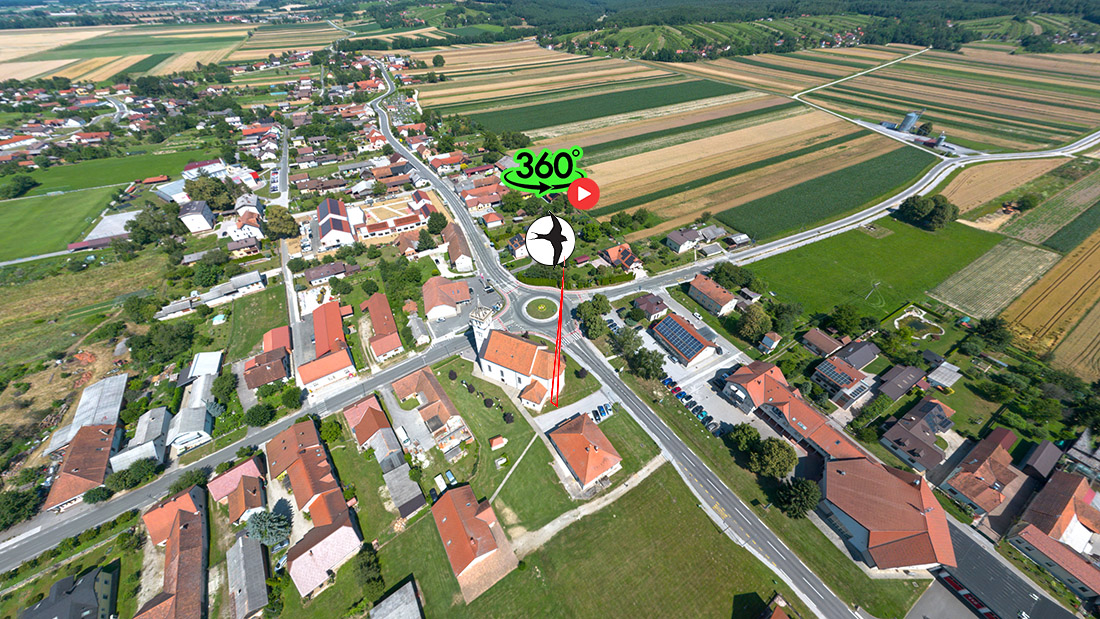
Dobrovnik (Hungarian Dobronak) is a settlement and the seat of the municipality of the same name in the far southeastern part of Slovenia. It lies northwest of Lendava, on the flatlands along the Bukovniški Potok stream, which flows toward the Ledava River and shapes a landscape of meadows, wetlands, and remnants of deciduous forests. The settlement is connected by local roads with Lendava (13 km) and Murska Sobota (20 km). About 3 km northeast of the village lies Bukovnk Lake, an artificial retention lake that today serves as an important recreational and tourist area.
Dobrovnik is situated in a transitional zone between the Pannonian plain and the gently rising slopes of the Goričko region. The climate is distinctly continental, with hot summers and cold winters, conditions that historically supported agriculture, viticulture on nearby hillsides, and forestry. The population is predominantly of Hungarian nationality, reflected in the bilingual character of the settlement, its cultural heritage, and local traditions.
Name of the Settlement
The name Dobrovnik derives from the Old Slavic word dǫbroνa, meaning oak or deciduous forest. This reflects the medieval landscape, which was largely covered by broadleaf woodland. The settlement is mentioned in written sources as early as 1322 as Dobronok, in 1322 and 1335 as Dobronuk, and in 1323 as Dobronak (Snoj, Etimološki slovar slovenskih zemljepisnih imen, 2009).
Historical Development
In the Middle Ages, Dobrovnik formed part of a large estate system on the outer edge of the Kingdom of Hungary. Due to its location among former marshes and forests, the area was sparsely populated but strategically important as a passage between the Lendava and Murska Sobota regions. The medieval parish of Dobrovnik included the villages Dobrovnik, Genterovci, Kamovci, Radmožanci, and Žitkovci, as well as five villages that today lie within Hungary. Because of proximity, worshippers from Strehovci traditionally attended services in Dobrovnik, although their village belongs to the Bogojina parish.
Language and Magyarization
The Slovene language was introduced into liturgy in Dobrovnik in 1839, when the parish temporarily included the village of Kobilje. In the second half of the 19th century, Hungarian state policy gradually imposed Hungarian as the sole church language. Parish yearbooks from 1889 and 1914 report that liturgy was conducted exclusively in Hungarian, reflecting broader processes of Magyarization in the Prekmurje region.
The Church of St James
Medieval Origins
The Church of St James is the central cultural and historical landmark of Dobrovnik. It is first mentioned in 1334, indicating an early foundation. The original church was likely Romanesque, suggested by the fact that its tower once stood separate from the nave. In the 17th century, traces of Gothic architecture were still visible.
Visitation records from the 17th century provide valuable insight:
-
In 1649, the church was masonry-built, with a vaulted sanctuary and sacristy, while the nave had a flat, painted wooden ceiling.
-
In 1669, it was described as deteriorated.
-
By 1688, it had been repaired: spacious, neatly whitewashed, with brick flooring, two elongated windows in the sanctuary, and three windows on the southern side of the nave.
A wooden pulpit stood along the northern wall of the nave, and a small wooden bell turret on the southern side. The rectory was wooden and roofed with reeds, typical of Prekmurje vernacular architecture.
Reconstruction in the 18th Century
A visitation report from 1811 states that the church was rebuilt between 1794 and 1796. The construction was financed by the parish and its patron, the noble Eszterházy family, which played an important role in ecclesiastical development in the region.
The present church consists of:
-
a Baroque nave with a sanctuary dating to 1797,
-
a Neo-Romanesque tower, completing the architectural ensemble,
-
a cemetery with a chapel surrounding the church, forming the traditional sacral core of the settlement.
20th-Century Renovations
The church underwent several renovations:
-
1978: interior renovation based on plans by architect Peter Požanek; academic painter Jože Zel created a biblical fresco in the presbytery; a new altar facing the congregation was installed.
-
1979: installation of two new bells (electrified in 1985).
-
1991–1992: extensive renovation of the exterior plaster and landscaping of the church surroundings.
Culture and Contemporary Life
Dobrovnik today is a distinctly bilingual community, where Slovene and Hungarian cultural traditions intertwine. Local cultural associations preserve folk heritage, music, and customs of the Hungarian minority. Bukovniško Lake and the surrounding forests have become a popular recreational area, known for walking trails, “energy points,” and the pilgrimage church of St Vitus.
The Municipality of Dobrovnik is one of three Slovenian municipalities with an autochthonous Hungarian national community, reflected in bilingual signage, education, and cultural life. The settlement retains the character of a peaceful Pannonian village, combining rich historical heritage, natural features, and a vibrant cultural identity.