

Veržej lies on the southern edge of the Mursko polje plain, on the right bank of the Mura River, in a transitional zone between the flat alluvial landscape and the slightly elevated terraces leading toward Ljutomer. Together with the villages of Banovci and Bunčani, it forms one of Slovenia’s smallest municipalities, covering only about 12 km². Despite its modest size, the area has a remarkably rich historical background.
For centuries, the Mura served as a border river between Austria and Hungary, giving Veržej a distinct frontier character. In 1342, the settlement obtained market-town rights, indicating its early economic importance. Between 1555 and 1605, Veržej was the seat of a Uskok voivodeship, a special military-administrative unit responsible for defending the border against Ottoman incursions. The Uskoks settled in the wider region between Ljutomer, Veržej and Radgona, and were renowned as skilled horsemen. From this period stems the long-standing equestrian tradition, still present in Veržej and its surroundings today.
In the 19th century, Veržej gained additional significance due to its proximity to the railway line between Pragersko and Hodoš, which stimulated trade and craftsmanship. Today, the settlement is known for cultural events, equestrian activities, and its preserved natural and technical heritage along the Mura.
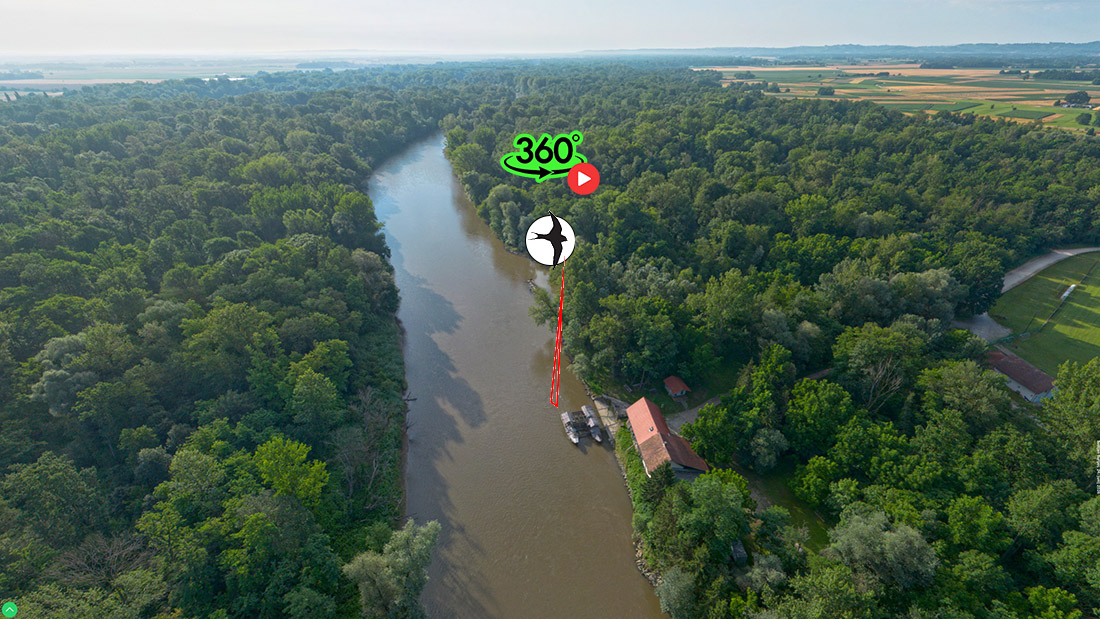
Floating Mills on the Mura River– Broader Context
Floating mills were once characteristic of the rivers of the Pannonian Basin, especially the Mura, Drava and Danube. They appeared on the Mura as early as the Middle Ages, reaching their peak in the 18th and 19th centuries.
How many mills were there?
-
In the 19th century, the Slovenian stretch of the Mura hosted more than 40 floating mills.
-
The densest concentration was between Radenci – Veržej – Ižakovci – Melinci – Petanjci – Razkrižje.
-
In some river sections, a mill stood every few hundred metres.
-
Milling was a major source of income, serving the needs of both Prlekija and Prekmurje.
Floating mills consisted of two connected boats:
-
the mill house, containing the millstones,
-
and the boat with the large waterwheel, driven by the river’s current.
After 1950, the mills began to disappear due to river regulation, changes in water flow, the rise of electric mills, and shifts in the rural economy. By the late 20th century, only a few examples remained, preserved as technical heritage.
Babič’s Mill – History, Significance and Present Condition
Babič’s Mill near Veržej is one of the last preserved floating mills on the Mura and one of the few in Europe that operated according to traditional principles until recently. A mill stood at this location already in the 19th century; the present reconstruction follows the original technology and local milling tradition.
For many years, the mill served as:
-
a tourist landmark of Veržej,
-
an educational example of technical heritage,
-
a symbol of life along the Mura,
-
a place where visitors could observe the functioning of the waterwheel, millstones and traditional milling techniques.
Condition in Summer 2026
By summer 2026, the mill unfortunately no longer operates. The reasons include:
-
changes in the Mura’s water regime (lower flow, rapid fluctuations),
-
technical difficulties in maintaining the waterwheel,
-
restoration costs exceeding the capacity of the private owner,
-
stricter safety and environmental regulations.
Nevertheless, the mill remains preserved as a cultural monument and is still open for visits. It represents one of the most important elements of the Mura’s technical heritage and is essential for understanding the former river-based economy that shaped life in Prlekija and Prekmurje for centuries.