

Veliki vrh (Veža) (2110 m elevation)
Velika Zelenica and Veliki vrh: the highest peaks of the eastern Dleskovška plateau
Velika Zelenica (2114 m) and Veliki vrh (2110 m) are the highest and most prominent peaks of the eastern part of the Dleskovška plateau. Together they form a distinctive, saddle‑shaped mountain massif rising above the northern escarpment of the plateau, offering some of the finest panoramic views in the Kamnik–Savinja Alps. Between them lies a broad grassy saddle, an important geomorphological and navigational landmark and a natural passage between the plateau’s karst interior and the precipitous northern cliffs above Robanov kot.
Velika Zelenica (2114 m)
Velika Zelenica is the highest peak of the Dleskovška plateau. Its summit area is wide, grassy, and gently saddle‑shaped. To the north, the terrain breaks abruptly into more than a thousand metres of cliffs above Robanov kot, while to the south it descends into the undulating karst landscape of dolines and alpine meadows.
Characteristics of Velika Zelenica
• a mostly grassy summit with scattered rocky outcrops
• steep, broken northern slopes shaped by frost weathering
• gentler southern slopes covered with grasslands and dolines
• exceptional views toward Robanov kot, Raduha, Ojstrica, Korošica, and the entire plateau
Because of its position, Velika Zelenica also acts as a climatic divide, separating the colder northern environment of Robanov kot from the more open and sunlit interior of the plateau.
Veliki vrh (2110 m)
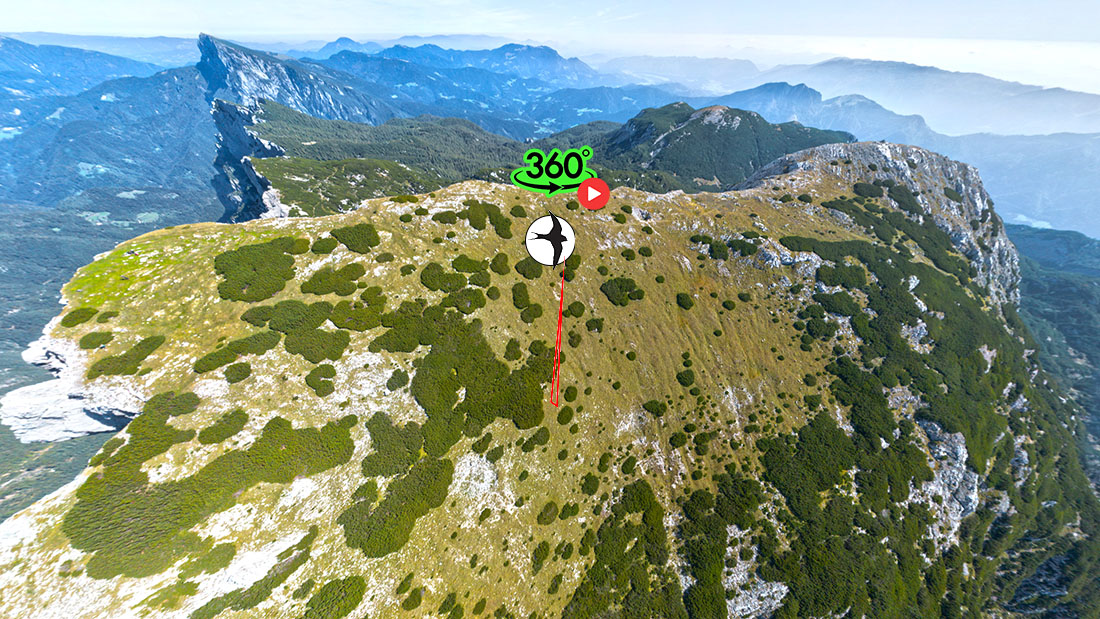
Veliki vrh is only a few metres lower than Velika Zelenica, but it is more conical and visually distinct. It rises as a separate grassy‑rocky peak on the eastern side of the saddle.
Characteristics of Veliki vrh
• more compact and rocky than Velika Zelenica
• eastern slopes descend toward Križevnik and the Savinja valley
• western slopes open toward the saddle and Velika Zelenica
• an important orientation point when traversing the eastern plateau
Veliki vrh is often used as a starting point for traverses toward the Polšakove Device, Križevnik, and Molička planina, and is frequently mentioned in mountaineering literature as a route junction.
The Saddle Between Velika Zelenica and Veliki vrh
The broad grassy saddle between the two peaks is one of the most recognizable relief features of the plateau. It serves as:
• a natural passage between the plateau’s interior and the northern escarpment
• a geomorphological junction where karst processes meet the erosional forces of the northern cliffs
• a watershed, with precipitation draining southward into the karst subsurface and northward toward Robanov kot
• a navigation hub, where routes from Ravne, Podvežak, Molička planina, and Križevnik converge
The saddle is also one of the most scenic viewpoints on the plateau: to the south it opens onto the rolling karst meadows, while to the north it overlooks the dramatic walls above Robanov kot.
Routes to Velika Zelenica and Veliki vrh
1) Route from Planina Ravne (the classic approach)
Planina Ravne is the most commonly used starting point for both peaks.
Route description:
• A marked trail leads from the pasture toward Korošica.
• After about 20 minutes, the path splits: right for Korošica, left for Velika Zelenica.
• The trail climbs across grassy ledges and past several dolines.
• The final section follows a broad grassy ridge leading directly to the saddle between the two peaks.
• From the saddle: 10 minutes to Velika Zelenica, 5–7 minutes to Veliki vrh.
Difficulty: easy marked trail
Time: 1 h 30 min – 1 h 45 min
2) Route from Planina Podvežak (the gentlest approach)
Planina Podvežak is the easiest access point to the plateau.
Route description:
• A wide trail leads toward Dleskovec and Ravne.
• After about 45 minutes, it joins the trail from Ravne.
• The ascent continues to the saddle and then to both peaks.
Difficulty: easy, suitable for less experienced hikers
Time: 2 h – 2 h 15 min
3) Route from Korošica (the most panoramic)
Korošica is a classic starting point for traversing the eastern plateau.
Route description:
• From the Kocbek hut, the trail climbs toward the saddle between the two peaks.
• The path crosses grassy slopes and is moderately steep but well‑trodden.
• The saddle is reached in 30–40 minutes.
• From there, both peaks are easily accessible.
Difficulty: easy to moderately demanding
Time: 45 min – 1 h
4) Route from Molička planina (the most varied)
A longer but very scenic approach.
Route description:
• From Molička planina, the trail climbs toward Molička peč and the chapel.
• It continues northeast and joins the route from Korošica.
• The ascent then proceeds to the saddle and the peaks.
Difficulty: moderately demanding
Time: 2 h 30 min – 3 h
5) Route from Robanov kot (the most demanding)
An alpine approach requiring good fitness and experience.
Route description:
• From Robanov kot, the trail leads toward Molička peč.
• A steep ascent follows across scree and grassy slopes.
• The trail joins the saddle below Velika Zelenica.
• The final ascent is shared with other routes.
Difficulty: demanding, partly exposed
Time: 3 h – 4 h
Velika Zelenica and Veliki vrh form the central panoramic ridge of the eastern Dleskovška plateau. Their shared saddle is a natural route junction linking the plateau’s karst interior with the northern cliffs above Robanov kot. The variety of approaches—from gentle paths from Podvežak to demanding ascents from Robanov kot—allows hikers to choose routes that match their experience and preferences.