

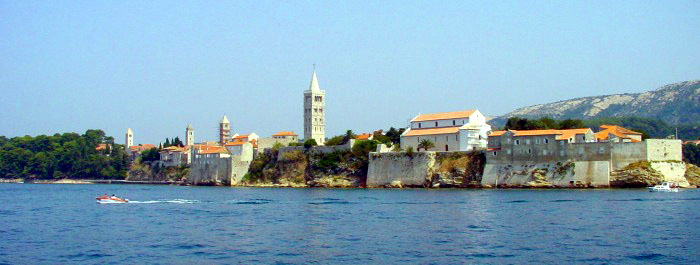
The Island of Rab: Geography, Settlements, and the Historic Town
1. Geographical Overview and Natural Landscape
The island of Rab is situated in the northern Adriatic Sea within Kvarner Bay, positioned between the islands of Krk to the north and Pag to the south, separated from the Croatian mainland by the Velebit Channel (Velebitski kanal). Covering an area of approximately 90.8 square kilometers, Rab is renowned for its remarkable climatic and geographical contrast:
-
The Northeast Ridge (Kamenjak): Directly exposed to the powerful, dry bura winds blowing off the Velebit mountain range, the northeastern side consists of rugged, barren limestone karst and steep cliffs. The highest elevation on the island is Mount Kamenjak (408 m), which acts as a massive natural shield against harsh weather conditions.
-
The Southwest Peninsula and Lowlands (Kalifront): Fully sheltered by the central mountain ridge, the southwestern part of the island is exceptionally fertile and green. The Kalifront Peninsula hosts the protected Dundo Forest Reserve, home to one of the best-preserved, centuries-old Holm oak (Quercus ilex) forests in the entire Mediterranean basin.
-
Climate and Coastline: Rab enjoys a mild Mediterranean climate with more than 2,400 hours of sunshine annually. The coastline is heavily indented, featuring crystal-clear rocky coves, secluded pebbled beaches, and wide sandy bays.
2. Overview of Island Settlements
Beyond its historic center, Rab consists of several distinct towns and villages, each characterized by unique topography and heritage:
-
Lopar: Located on the northernmost peninsula, Lopar is famous for its unique geology, yielding over 20 shallow sandy beaches, most notably the 1.5 km long Paradise Beach (Rajska plaža). Legend also names Lopar as the birthplace of Saint Marinus (San Marino), the stonecutter who founded the Republic of San Marino in 301 AD.
-
Supetarska Draga: Situated around a deep, naturally protected marine bay with three small uninhabited islets (Maman, Srednjak, Sailovac). It is home to the 11th-century Benedictine Basilica of Saint Peter, the oldest preserved church on the island, featuring ancient Roman architectural spolia and the oldest church bell in the Adriatic (cast in 1299).
-
Kampor: Nestled along the wide, shallow Kampor Bay, this village preserves traditional architecture and agricultural life. At the edge of the bay lies the 15th-century Franciscan Monastery of Saint Euphemia (Sveta Eufemija), which houses an extensive ethnographic museum, an illuminated codex collection, and the polyptych of the Venetian master Bartolomeo Vivarini (1458).
-
Banjol and Barbat: Stretching along the southern Barbatski Channel opposite the island of Dolin, these coastal settlements are renowned for nautical tourism, boatbuilding traditions, and protected sandy-pebble coves known as Padove. On the hill above Barbat stand the remnants of a 6th-century Justinian Byzantine military fortress (Sv. Damjan).
-
Palit and Mundanije: Palit borders the town of Rab directly along the bay of Saint Euphemia and the popular municipal beach Škver. Mundanije, situated in the fertile central valley (Rapska dolina), is the only inland settlement on the island, historically serving as its agricultural backbone for wine, olives, and fresh produce.
3. The Historic Town of Rab
The Town of Rab is the historical, cultural, and administrative nucleus of the island. It is dramatically situated on a narrow, elongated rocky peninsula flanked by the Town Port on one side and the Bay of Saint Euphemia on the other.
Town Rab has a long recorded history that dates back to the year 10 BC, when it was mentioned in an old Roman document by which the Roman emperor Augustus proclaimed it as a municipium with granted independence (Municipium Arba). Although little is left of the antique town, Rab abounds in early and late Romanesque architecture.
Key Urban and Architectural Highlights:
-
The Four Iconic Bell Towers: Rising vertically along the crest of the cliff, the silhouette of Rab famously resembles a four-masted sailing ship:
-
Bell Tower of the Cathedral of the Assumption of the Blessed Virgin Mary (12th century): Standing 26 meters tall, this masterwork of Romanesque stone masonry features four tiered levels of bifora and quadrifora windows.
-
Bell Tower of the Basilica of Saint John the Evangelist: The sole intact remnant of a massive three-nave Early Christian and Romanesque basilica.
-
Bell Tower of the Church of Saint Justina: A 16th-century Renaissance addition with a distinctive bulbous dome, currently housing a collection of sacred art.
-
Bell Tower of the Monastery of Saint Andrew (1181): The oldest Romanesque bell tower on the island, adjacent to the working Benedictine cloistered nunnery.
-
-
Urban Layout and Medieval Palaces: The town is structured around three parallel longitudinal stone streets: Donja ulica (Lower Street), Srednja ulica (Middle Street), and Gornja ulica (Upper Street), linked by narrow stairways and vaulted alleyways (volti). Prominent secular monuments include the Rector’s Palace (Knežev dvor) on Trg Municipium Arba, the Gothic-Renaissance Dominis-Nimira Palace, and the historic City Loggia (Gradska loža, 1509).
-
Komrčar Park: Directly bordering the northern medieval ramparts and the defensive sea walls, this lush urban park was designed and planted in 1890 under Chief Forester Pravdoje de Belia. Today it serves as a botanical haven of Aleppo pines, Mediterranean cypresses, century-old agaves, and fragrant bay laurels, with shaded paths descending straight to the seaside promenade.