

General Information
Capital: Vienna
Population: approximately 8.1 million
Total Area: 83,870 km² (Land: 82,444 km²)
Highest Point: Grossglockner – 3,798 m
Lowest Point: Lake Neusiedl (115 m)
Longest Glacier: Pasterze Glacier
Austria is about 4× larger than Slovenia.
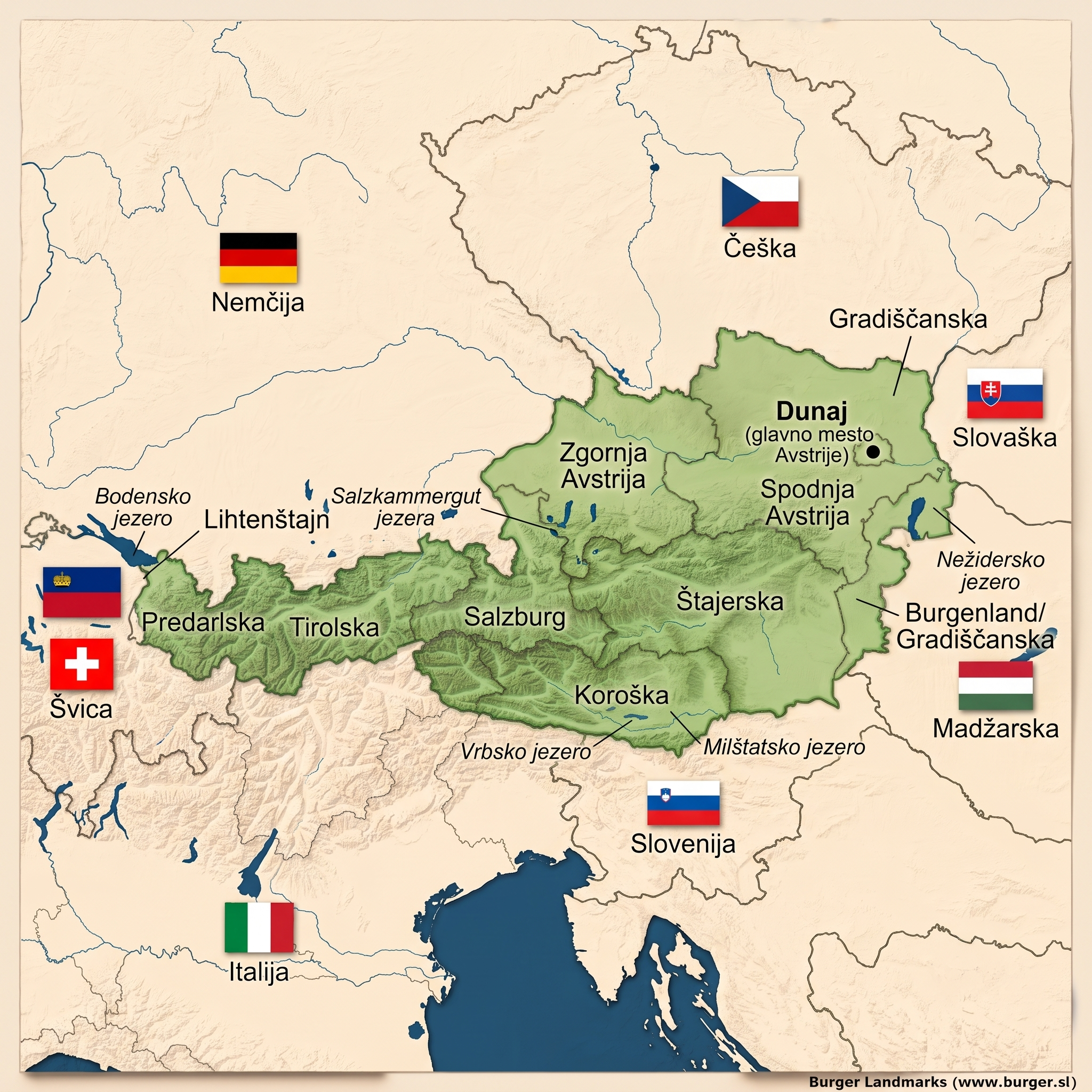
Regions of Austria
- The Alps: High peaks, glaciers, and ski resorts
- Vienna Basin: Capital region, imperial palaces, culture
- Danube Corridor: River landscapes and Wachau valley
- Salzkammergut: Lakes, spas, and historic towns
Featured Landmarks
- Schönbrunn Palace: Imperial residence and gardens
- Hallstatt: UNESCO World Heritage lakeside town
- Grossglockner: Austria's highest peak and alpine road
- Melk Abbey: Baroque monastery above the Danube
Austria – a Crossroads of the Alps, History, and European Identity
Austria is one of those countries where natural landscapes, historical heritage, and contemporary European culture blend into a harmonious whole. Although not large in size, its influence on European history, art, and politics is remarkable. From alpine peaks to Vienna’s grand boulevards, from Mozart’s scores to modern diplomacy, Austria is a place where tradition and modernity meet in a distinctive and confident identity.
Geographical Location
Austria lies in the heart of Europe and borders eight countries: Germany, the Czech Republic, Slovakia, Hungary, Slovenia, Italy, Switzerland, and Liechtenstein. This position places it at an important crossroads of transport and culture, where Central European, Alpine, and Pannonian influences converge. Most of its territory is covered by the Alps, which shape the climate, economy, and way of life. Only the eastern part opens into the Pannonian Plain, known for vineyards and gentler landscapes.
Geology and Natural Features
Geologically, Austria is a distinctly alpine country. The Alps were formed by the uplift and folding of the Earth’s crust caused by the collision of the African and Eurasian tectonic plates, creating a complex structure of limestone, dolomite, crystalline rocks, and glacial formations. The highest peak, Grossglockner, rises to 3,798 meters and stands as a symbol of the Austrian mountains.
Glaciers, U-shaped valleys, karst landscapes, and alpine rivers — including the Danube, Inn, and Drava — have shaped a varied relief. The eastern regions are geologically younger, with softer sedimentary layers that provide fertile soils and support viticulture.
History
Austria’s history is closely tied to the rise and influence of the Habsburg dynasty, which from the late Middle Ages to the early 20th century shaped the political landscape of Central Europe. Vienna served for centuries as the capital of a multinational empire that united diverse peoples, languages, and cultures.
After the dissolution of Austria-Hungary in 1918, Austria became a republic, though the interwar period was marked by political instability. In 1938 it was annexed by Nazi Germany, an event that left deep scars in the national memory. After the Second World War, the country regained independence and in 1955 adopted the principle of permanent neutrality, which became a defining element of its identity.
In the second half of the 20th century, Austria developed into a stable, prosperous, and internationally respected state. Its accession to the European Union in 1995 further strengthened its role within Europe.
Modern Economy
Austria’s economy is among the most developed in Europe. It is built on a combination of industry, services, and high‑tech sectors. Key components include:
-
Industry – mechanical engineering, automotive components, metalworking, pharmaceuticals
-
Tourism – the Alps, the cultural heritage of Vienna and Salzburg, spa resorts
-
Agriculture – dairy production, viticulture, organic farming
-
Services – banking, logistics, international organizations
Austria is known for its high quality of life, social security, and well-developed infrastructure. Its economy is stable, export-oriented, and closely connected with Germany and other EU countries.
Political System
Austria is a federal republic composed of nine federal states. It has a parliamentary system in which the president performs mainly ceremonial duties, while the government is accountable to parliament. The political landscape is traditionally shaped by centrist and center-right parties, with a strong tradition of social partnership based on cooperation between employers, trade unions, and the state.
Culture
Austrian culture is deeply rooted in European tradition yet remains remarkably diverse. Some of its most recognizable elements include:
-
Music, especially classical; Austria is the homeland of Mozart, Haydn, Schubert, Strauss, and Mahler
-
Architecture, from baroque palaces to Secessionist masterpieces and modern cultural venues
-
Literature, with authors such as Stefan Zweig, Ingeborg Bachmann, and Thomas Bernhard
-
Cuisine, famous for Wiener Schnitzel, apple strudel, coffeehouse culture, and wines from Styria and Burgenland
-
Art and philosophy, from the Vienna Secession to the psychoanalysis of Sigmund Freud
Austrian culture is a blend of elegance, intellectual curiosity, and a strong sense of tradition that continues to shape contemporary life.